
(music fades in)
Alexandria 0:09 Welcome back to Interrupting Racism. Thank you for joining me for Part B of the episode entitled Black Girl Magic. Status quo would have it that white supremacy reigns, People of Color remain in a marginalized status, that black lives and trans lives continue to not matter, heteronormative patriarchy keeps a chokehold on society, the rich get richer and the poor get poorer until they’ve given up hope, repeated toxic patterns for generations, ended up in jail or six feet under. Everything that we do in opposition to the status quo is interrupting racism.
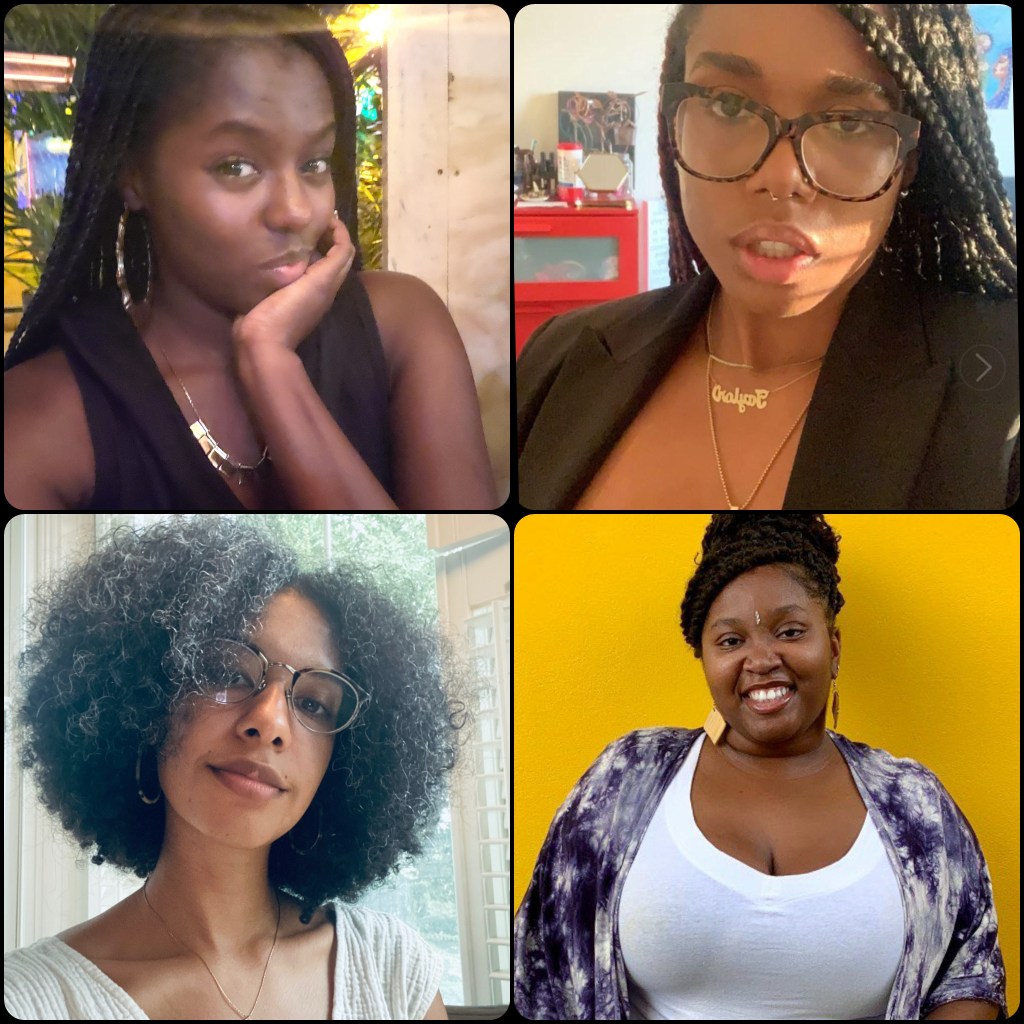
In today’s episode I’m bringing back three of my very good friends to finish our conversation about our experiences as Millennial and Gen Z Black women just trying to navigate life in the US. We actually had so much fun recording this episode that I decided to put it into two parts because I didn’t want you all to miss out on anything we had to talk about. If you missed Part A of this conversation, which was released two weeks ago, be sure to head back and listen to that one first so that you get the full picture of who these women are, why they’re so dope, and how we all know each other. All right, let me bring back my guests and friends, Taylor, Elle and Lorice to finish our Black Girl Magic conversation.
(music fades out underneath)
Alexandria 1:32 Hey, my lovely sister friends, thank you again for participating in my show. Can you all just remind the folks about who you are and what you be doin’?
Ellie 1:40 Hello everyone. My name is Ellie. I’m currently based in Providence, Rhode Island, creative juggling work at Brown University in the department of Africana studies with the graphic design business Autipacha Studios. if you need to design. I’m passionate about transformative politics, the pursuit of new knowledge. To keep me busy, to feed my soul, I practice yoga and make playlists. And I keep my community of friends, as close as humanly possible. And if all this strikes you is kind of Aquarius, you are correct. So happy to be here, Alex.
Lorice 2:17 Hey y’all Hey, my name is Lorice, I’m from Brooklyn, New York, I’m a Caribbean American my passions are the intersections between the law and public policy advocacy and educating others. When I’m not exploring community care and alternatives to incarceration, you will find me reading books, listening to music specifically Soca and dancehall and playing among us with my friends. I recently graduated to pay for my degree in Political Science and prison studies, and right now I’m a working girl. This pandemic did not keep me that far down. So I’m a legislative director for the University Student Senate for CUNY.
Taylor 2:52 Hi everyone, my name is Taylor Jane Veasley. You can call me today if you’d like. I’m from West Philly, born and raised. I graduated in 2018 with a degree in Political Science and Africana Studies. I’m currently a second year law student at Temple University. My legal focus is in transactional law, specifically in mergers and acquisitions. But if I’m not studying, which doesn’t happen a lot. You can catch me perfecting my piecrust recipes, watching the crime, sci-fi or The Office, more specifically, or reading about black liberation, or buy and plant. That’s what I also do. So I’m very happy to be here, very grateful to be here in community with my lovely women, and excited to be a part of this podcast.
Alexandria 3:33 All right, so I guess I want to start getting into some of the questions about things that we kind of talk about all the time and so one of the questions is, what are some of the stereotypes in society that you think affects black woman’s ability to thrive, whether that be in career in love, or just in wider society.
Taylor 3:53 I immediately have one that I was going to try to rethink and mold a different one, but I’m not that’s tired. I think one that I thought was interesting like spiritually someone told me about this word yesterday as Alex also knows but, the word assertive. And I think and–I know that’s a word that like I probably ran through all of our minds I’m sorry, because it’s a word that’s associated with black women often. I grew up with a mother that prides herself in her assertiveness. I grew up with a mother that is unapologetic about her assertiveness and about demanding what she wants and not bowing down to anyone if she doesn’t get it. And I haven’t adopted all of that, but I do think that in certain ways specifically it shows itself in romantic relationships.
I think I’ve been called assertive in every romantic relationship I’ve been in. By women that have been observing my relationship, as well as by the men that I’m in it with. Either assertive or aggressive, those kind of seem interchangeable for some people. And I think where that comes from is, is literally just the thought that like you want something out of a relationship or a job or whatever it is, and you will not lower those standards, just because someone’s not willing to meet you there. And that’s called aggressive or assertive or if you’re like, you know, I need this. That’s called aggressive or, like, like expressing your wants and needs, which is a basic human action is, is you know perceived as aggressive or assertive.
I’ve been told by tons of other women like “you’re being so mean like you’re being so mean to him like, stop being so mean to him”. Like, you know, even in jobs. I tend to kind of play the opposite role I tend to take a back seat, which I’ve been trying to work on, because I don’t want to be perceived as that and I don’t want to be perceived as like a threat or as you know whatever insert here. And I want to just do a good job and keep my head down, in whatever it may be, especially in like the legal field is very, very very white, very very male. And so trying to find that balance that sweet spot of demanding what I need and expressing my needs. But in a way that feels good to me, and not–and sometimes I go the opposite way because I’m trying to overplay because I’m like you think I’m about to be aggressive assertive, so I’m about to show you aggressive and assertive and you bout to get this work. Like that also doesn’t hit.
So it’s like I don’t hate either. So finding that sweet spot that feels authentic to me I think has been quite a journey, and I’ve really been pulling from like my mother and other strong women that I know and just kind of thinking; What does it look like to be unapologetically assertive and demand what you want in every single– whether it’s a random person on the street or your boss or the head of the company or a girlfriend, a close– your best friend? What does that look like? And you know when someone does– isn’t willing to meet your needs, then it’s time to Is it time to walk away? Or is it time to, you know, re-evaluate or whatever it may be, but I think that’s something I don’t want to back away from being aggressive or assertive, but I do need to find that sweet spot and I think that’s something that a lot of black women face, you know, being told or kind of think through on their own.
Alexandria 6:51 Ditto. That assertive not letting that go.
Ellie 6:54 It’s so interesting Taylor because that’s one of the things that I’ve always admired most about you is that you are a person in my life that has always been a model of “I said what I said, this is what I need, can you meet me or not. If you can’t, you know what to do”. And it has always been like a “what would Taylor do in this situation?”, and that’s always been like a well of strength to be like…
Taylor 7:13 Oh well, thank you.
Ellie 7:15 I know that it’s something that you feel like, you know you’re trying to like find the sweet spot for but people are already looking at you like “that’s how you do it”.
(laughter)
Alexandria 7:26 But you know what? And that’s just making me think about the birthday video that we did for Taylor, like all —
Taylor 7:31 I’m gonna cry like that birthday video literally made me wanna cry.
Alexandria 7:33 Like that birthday video, there was like common themes right like of like words. People were always like “she’s very ambitious, she knows, that like she’s headstrong she knows what she wants”. And I think that that kind of goes with assertive too and people love to see that as a negative but it’s not everybody in your life knows that you know what you want so who’s gonna stop you?
Taylor 7:55 Thank you, thank you, ase to that. Thank you, it’s hard to balance and it’s hard to hear from all different angles, but that’s why I appreciate my girlfriend’s–
Alexandria 8:07 Sistah-friends!
Taylor 8:08 –to remind me. Sistah-friends! Yes.
Lorice 8:11 There’s so many thoughts that came to my mind when you started speaking about that I don’t even know if I’m gonna share them or not cuz its just like its a whole new pathway to the conversation. I just think about like how many people try to tear a black woman down for being like your angry black woman but also try to profit off of it at the same time. In like the sense of like characters, or if somebody tries to pick it up in a meeting, they’re like, “oh, you’re just angry” and you make your dramatic exit. And then Sally is like “so yeah as Taylor was saying” and I’m just like, “what?”.
(laughter)
Lorice 8:39 Okay, so if I might sound like I’ma cry It’s cause I’m a cancer but this is also personal. So, I think something that affects Black women’s ability, this could also apply to Black people, but the ability to love its a sense that Black women are expected to be a monolith. And then, that monolith is not something that I always subscribe to. Now I feel it very deeply because it was like in a previous relationship, in the sense where “all Black women are ratchet, all Black women are loud”. Okay yeah I’m ratchet and loud, but I can also fit these other personas at different moments of time. And just because you don’t have access to them, does not mean that that’s who I am. And I also think about people who are like alternative, or like just really girly, or really feminine, or really masculine. I think about them because sometimes they’re also like I’m not in spaces to find love for this because it’s weird for this to be attached to being Black. It’s very complex, and I think it hurts the possibilities of finding love. It’s either because I’m too much of this or not enough of that. And it’s hard to find somebody thats going to accept me as myself, but as a root of being a Black woman.
Taylor 9:50 But I will say Lorice, you are a very well rounded woman. Like you are one of those people that is just, you do– and I like what you said like “just because you don’t have access to that, does not mean it does not exist”. Honey. Sweetheart. Like and I love that you said that because that’s real you have so many different complexities to you as, you know, as Black women do. And I think, you know, that was a vulnerable moment, so I thank you for sharing.
Alexandria 10:14 Definitely.
Taylor 10:15 For sure.
Alexandria 10:16 I think I’ll jump in. Ya’ll mentioned things that are legit and I think another stereotype like going off of the angry Black woman and even struggling with being sensitive or having sensitivities or just being somewhere off the beaten path of monolith like, there’s just so many expectations for Black women. It’s like, we can talk about it later in the culture part but I think there’s a meme that comes to mind right now. It’s a Black woman, literally drowning in the ocean. And her hands are coming out of the water, and instead of trying to save her, someone like gives her a high five. Like “yes girl you are so strong, you’ve got this!”.
(laughter)
Lorice 10:56 And that’s like what Ellie was talking about earlier.
Alexandria 10:58 Like, it’s like we’re laughing because it’s funny right when you see it on like a meme, like in like a Foursquare meme. But legit like that’s what it feels like sometimes. Sometimes we are like going through it. Like being drugged through the mud at work, at school, just in society I could be I could walk into a store and somebody just you know whatever. I’m could be having a bad day. Like we’re expected every thing of us but not entitled to do anything like that we that we choose to do. So I feel like we’re expected to be strong. We’re expected to be, you know, assertive because that’s what Black women are but, if you’re assertive, then it’s bad. You know, when it’s when it’s convenient for them, then it’s cool. But when it’s not, then it’s bad.
I think, yeah, we’re not allowed to be angry. Anger is an emotion that every other person is allowed to have but as soon as the black woman gets angry it’s. “Oh well, oh uhh. We don’t know what’s about to happen”. I have a right to be angry, we’re expected to just deal with whatever comes our way. And no one’s trying to lift us up there just “Go ahead Black woman! You’re so strong! Black women are so strong. Go girl go!”. And it’s wack! I’m tired of it because, yeah, I’m angry because I’m, I’m overrun when I think about career and just trying to thrive–I was actually talking to my cousin earlier today, my younger cousin. And I was like, I used to work at a store. I worked there for five years. I started as a sales associate. Moved on to be a supervisor. Moved on to be an assistant store manager. I really loved what I was doing. I was working with in the optical field and I really loved it. Like it was interesting I liked it a lot. I’m great with customers, I’m a good manager, I love people. But I literally in those five years, and in those two promotions that I had, I only made like $4 and like 90 cents more. Like what? Huh? So like–
Lorice 12:43 That don’t add up.
Alexandria 12:45–what? And then I had a, there was one person above me, the store manager was literally making like $55,000 more than I was, and I was doing all of his work. And he would put it as well “You need to do this work because if you’re ever going to be a store manager you have to know how to do it”. And I was like “Yeah but, when are you gonna do it?” So it just black women are just expected to just take it, take everything! Take the disrespect that comes your way, just take it all. For people, they just put these expectations on us and we have to fulfill them at our own detriment and, and we’re not allowed to feel anything. We’re supposed to just do.
Ellie 13:19 I think for me, and this is something that I’ve struggled with kind of going back to like reframing achievement is as a Black woman, they’re just more eyes on you. *Snaps* There are more people interested in what you are doing, and how it turns out for you than if you were just any ole other body. And knowing that, and feeling that pressure makes me hesitant to try sometimes. *Snaps* Because I’m thinking about how the end result is going to reflect on me and everyone else that I’m supposed to be reflecting when I’m the only person, you know the only representative of Black women as this monolith, like the Reese was talking about, at the table. And I’ve been trying to tell myself that, you know, to thrive, is to try and the more times you just get up and do something, the less scary it is the more familiar it is the more you learn, the more like creative energy that you will release.
Anything that is worth doing is worth doing poorly. *Snaps* And for me to just like, give it a shot? Whether it’s something that I have trained for a long time for, like that doesn’t matter. Something that I have the first inkling about how to actually do, it doesn’t really matter. It’s just do I want to do it? Okay, let’s do it. And I’ve seen so many times, you know, watching my friends be like “Oh, I don’t know if I’m going to be good at that”. It’s like, well, you must go and you must try. And one of the things that I heard so early on in my Vassar career is, you know me sitting in a class after having read a difficult reading. The professor is like “alright so what do ya’ll think?”. And I know for a fact that Chad with the backwards baseball cap did not read. He didn’t read as closely as I did. He didn’t think– he didn’t have the experience necessarily to engage with the material, the way that I might, but whose hand was up? *Snaps* Not mine.
Alexandria & Taylor 15:09 Go off!
Ellie 15:10 Just like, at what point am I going to be like, I don’t care if my thought is half formed? I don’t care if I like pull it together while I’m talking. I’m going to open my mouth and take up the space that I deserve. And that’s that
Alexandria 15:19 Yes.
Taylor 15:20 Yes.
Lorice 15:26 You know what’s worse than Chad? Is when you make a profound statement and its a pause. And somebody’s like–
(screams of agreeability)
Lorice 15:29 –”just to piggyback on what Ellie was saying”
(gasps and uproar)
Taylor 15:33 And you be like “No!”
Lorice 15:36 What’s worse is that she wants to piggyback and don’t say nothing different than what Ellie just said.
(more uproar)
Taylor 15:43 Verbatim, repeat.
Ellie 15:44 “You know, I just want to offer another opinion”.
Alexandria 15:45 And don’t forget that everybody goes “wow you’re right!” as if Ellie didn’t just say that exact–like that stuff is– You’ll be like, “no guys, I just said that”. And their like, “no but she said, no but she was adding something to it”
Taylor 16:00 (Mockingly) Nuance.
Lorice 16:02 And now, Ellie’s speaking too much. Ellie’s speaking too much in class.
Taylor 16:07 “Like, remember one of our norms is step up, step back”. And you’re like, you know what?,
Alexandria 16:11 That’s very real.
Taylor 16:13 Very real.
Alexandria 16:14 That’s very, very real.
Lorice 16:17 I felt that.
(laughter)
Taylor 16:19 No, I felt that if my like spirit. And literally like a montage of like events. Of like every time I was like I was literally– and I think it goes hand in hand with your thinking of the answer but you’re like, “that’s probably not even right”. And then someone else raises their hand and they say it. And you’re like– (sigh). And it’s not even like–the way you would, you would have really said it. But they say it and you’re like, “you know, I need to like get my own thoughts to the class”. I think that, like, even if it’s half-baked, even if it’s like–whatever
Alexandria 16:45 You know, I think that even that thought process goes back to just the way society works. Remember we used to have that chalkboard in our kitchen? And there was that quote, that lived on it for the longest time? And it was like “Have the courage of a mediocre white man, with that you can do anything”. I wrote it, because I was like no y’all, like– because it was so you know, Ellie was just saying like it’s some mediocre guy in the back of the class who didn’t read. Who doesn’t actually care. He read the like spark notes like now he’s in class like trying to sound like Einstein, and you’re here like hmmm.
Lorice 17:21 No but that’s real as– Because that white person is gonna be like “this is a profound thought”. But the moment you start speaking they be like can you have profound thoughts? No. You have to have receipts. You have to have books and essays.
*claps*
Alexandria 17:30 Right. And so it’s wack. Because we’re always taught, well maybe you should second guess because you don’t want to be embarrassed. You don’t want somebody to be like, “I don’t know, Ellie like maybe you’re just being a little negative, I think we all have a right to an opinion”. Like there’s always some nonsense that comes your way. So you do second guess yourself and it sucks because there are people out there who don’t. I don’t care what it sounds like I’m gonna say it and if you don’t like it, oh well. But their whole race and their whole gender is not on their back when they speak.
Taylor 17:55 On their back.
Alexandria 17:56 Like we are holding other Black women, and other black people because we be in places that other people are not and we’re holding them on our back. And anything that we say, it’s like, “Oh well, there goes the black girl. I don’t know–”
Taylor 18:09 Yea. I think it also like even in like jobs or internships is like, you’re the only Black girl in your department or only Black woman in your whatever. And they’re like “you know, you gotta”– I literally was told this and my last thing, they were like you know, my Black manager is like “you know like we don’t have a lot of Black women interns, you’re showing them why we should have more”. And it’s like, what if I don’t do a good job? Like, I am not a representative of like every single Black woman. So if I don’t do an amazing job ya’ll are never gonna hire another Black woman? Like what’s the tea on that, like? It’s just it’s like a very strange–
Lorice 18:41 I’m glad that you guys like you Alex and Ellie are bringing it up, even though like we’re laughing about it in the context of education it’s literally in every aspect of our lives, and Taylor what I’m like what you’re bringing up for me is the beauty and the harm of Black Excellence. It’s like I’m glad you’re doing this. People haven’t allowed us to do it, you’re doing it now. And it’s like “well you gotta be at the forefront for the people”. But I’m like, I didn’t ask for that though. *Snaps* I didn’t ask to be the token.
(Sponsorship)
Alexandria 19:10 All right, so, hmm. I think we should go into– let’s, let’s talk about the culture. Let’s get into the culture.
(bongo plays)
Alexandria 19:19 So what are some new themes or trends that have caught your attention, and why? Have you seen any inspiring videos or posts lately? Any like funny or interesting memes or whatever? I’m gonna start since everybody’s looking like “hmm”. So, actually, I saw this meme was on Lorice’s story the other day. And I came across it, and I liked it like so much that I responded to Lorice and then I went to the actual page and then I commented on it. And it was kind of what I was talking about earlier about being in the workplace and so let me share my screen real quick. So it’s called the problem, quote on quote, “The Problem Woman of Color In The Workplace”. And so it starts us right it’s the woman of color enters the organization. Actually let me step back, this was posted on the page for Chloe and Chad, and it looks like it says that it’s adapted from The Chronicle of The Problem Woman of Color In A Nonprofit, by The Safehouse–
Lorice 20:50 You better read that fine print.
Alexandria 20:53 Listen, I don’t need nobody being like “that’s my and that’s my intellectual property and you–”. Uh-uh-uh!
Lorice 21:01 I’m saying, I got glasses and couldn’t read that.
(laughter)
Alexandria 21:04 So it’s adapted from The Chronicle of The Problem Woman of Color In A Nonprofit, by The Safehouse Progressive Alliance For Non Violence. And so there’s a woman of color enters an organization. And then there’s white leadership, and this is when you’re in the honeymoon phase right the woman of color feels welcome, needed and happy, but you’re also a tokenized hire. And then we move into reality where the woman of color points out issues in the organization. She tries to work within the organization structure and policies, and she pushes for accountability. And so, this is like repetitive injury and microaggressions, that’s what’s happening right now.
So then we move into response. There’s a denial of racism and the response is the organization denies, ignores, and blames, and then the responsibility of fixing the problem is placed on the woman of color. And then people of color are pitted against one another. And then we move into like a target and attack of the woman of color. And that’s when we get into retaliation. The organization decides that the woman of color is the problem and targets her. And the organization labels the conflict as a quote, communication issue or claims that she is not qualified, or quote, not a good fit for the organization. And then the woman of color, essentially, exits the organization.
This hit me so hard! Because this has been my experience, everywhere that I have worked, essentially, like, of course there’s like exceptions to the rule but that, like, this is how it goes. And someone just like, put it together on a host and I was like wow, I’m shook.
Lorice 22:40 They gaslighted her to the max.
Alexandria 22:44 And I guess I don’t know, I mean, I’m older than y’all so I’ve been in a few organizations and I’m like *laughs* I’m an audacious person. And so I do push back right like I entered a really large organization that I always wanted to work for. And I entered and the same kind of thing happened, and I was like “yeah, so there are these problems but like I have some solutions. Like you could do this, you do that”. And everybody was like,” oh no, that’s not our job, there’s a department for that. There’s like a whole department that works on like DNI. Mmm-hmm. We don’t touch that.” And I was like “yeah but you’re a Vice President. Like you could like, you have some pull. Like you can sit, you know, make some things work”. And then you just become the problem so it’s really hard it’s either like come in and just accept whatever it is throwing at you or don’t have a job, like, take your fit or sit there and take the attacks every day and like, and feel terrible. Yeah.
Lorice 23:32 The wild thing is that it’s not limited to just having jobs, I mean like its in the community work, to friend groups, to being in clubs on campus.
Alexandria 23:44 Word. I guess I’m curious. I’m always trying to remind myself like silence is not a bad thing. Like what’s going on in the silence? So I’m just curious about what’s going through your head right now.
Ellie 23:53 I’m just thinking about Wow, I’m not crazy. Like, this happens to everybody. I mean I think that that kind, of that kind of process is so institutionalized. And we don’t really think about it as someone that goes through it in multiple organizations as something that might feel so natural that it has just become kind of unspoken corporate group whatever practice. And I think that it’s no mistake that this happens so frequently when there are few Black women at the table. And I think that in situations that I’ve been in where there have been perhaps me and one other Black woman, there was always kind of an attempt to keep us from being on the same team, *Snaps* and working on the same projects. Because once you start sharing your experiences and talking about things that’s going on, then it’s like, “Oh so it’s not just me. It’s both of us.”
Lorice 24:47 “You’re forming a cult now!”
Taylor 24:49 Mmm-hmm.
Ellie 24:51 And– Right, exactly. And so by keeping the sort of distance, there is more control. And that’s, that’s what was going through my head. In that moment.
Alexandria 25:24 Mmmm that’s, yeah that’s very real.
Lorice 25:57 I was also looking at like videos and stuff that I’ve saved. But I’m right now like heavily thinking about the part in the meme, I wish I still had it pulled up. It’s just where like the dysfunction now of the people color, or the Black woman, or Black people in the job and where its like–It makes me just think about like intergroup differences– or intra. I’m sorry, small word, big difference. But in the sense of like side comment, same idea. In a sense where people are like prison abolition versus prison reform. And it’s like, at the end of the day, people worry more about how are we getting there, instead of like getting there and it causes confusion inward and we never realize what the actual problem is. And it creates this crazy dysfunction where it like yo, it’s not us against us. It’s a large statement I’m making right now and I’m not explaining it well. But thats I’m feeling about the whole like response and retaliation portion.
Alexandria 26:20 You’re making me think about like, kind of like something like big that’s been going on now. And I’m not gonna go too deep into it but like, former President Barack Obama had something to say about like changing the words like “Defund The Police”. And that caused like a huge rift in the Black community. Like there are people who were like, “Barack Obama can do nothing wrong, he can say nothing wrong. Like, why are you criticizing him if he has something to say about it then maybe he’s right”. And then there’s the other side of people and I think I probably fall on this side like I, you know, I respect him. I love Mr. Barack Obama. But I think he’s a human. Like, he can say things that I don’t agree with necessarily and I think, yeah.
I think Lorice, what I’m gathering from what you’re saying is like we get so stuck on something. Like even like the words like “Defund The Police”. No matter how many times people have tried to explain that no one’s saying, “Get rid of the police department”. That’s not what we’re saying. What we’re saying is they have lots of money. Let’s take some of that money and disperse it in other places, and instead what people are hearing is “shut down police departments”. And I think it’s those kinds of conversations and it’s like, you know, with having the divisiveness of like Barack Obama saying something and everybody going like either you’re for or you’re against, we lose sight of what we’re actually trying to do. And essentially we’re all trying to do the same thing. We just don’t like the wording, and then we get stuck on that part and forget that we had a whole goal ahead of us.
Lorice 27:40 Even if it was a different wording or just different methodologies. And then attacking each other for having like those differences. And it’s like, were we trying to do something in the first place? Thank you for picking that up. Cuz I was like “English is not coming out right now”.
Alexandria 27:49 I got you. Sometimes, like “did I hit the point I was trying to hit?”. Help me out ya’ll. So I decided that I would like to ask all of my guests: What does Interrupting Racism mean to you? So what does it look like, what does it mean to interrupt racism. It’s the name of the show and I want people to understand that it has multiple meanings, and that there’s so many routes to get there.
Lorice 28:10 I want to say my initial thought.
Alexandria 28:11 Yeah.
Lorice 28:12 I think that interrupting racism on the bare minimum is to have a thought, to have a question. To think about how the world works, and then be like “Why?”. To look at each other and be like, “Is this the best way of community care?”. Or just to think about the norms that we normalize. And I think what’s the next step is to like have that conversation, and to bring those actions. Whatever that conversation and actions look like might be different for everybody. But what I would like to encourage everyone is to think, and to question. I sometimes speak in question. My diary is literally questions. And I’ll respond to my question with another question. *Snaps* Because I think what people don’t want you to do, people don’t want you to think. And people don’t want to disrupt. And they’re like “it’s okay”, and it’s not. So if I can encourage anything its to do just that, to think and to question.
Alexandria 29:15 Hmm. I like that.
Taylor 29:18 I think what Lorice just said reminded me of the Angela Davis quote of like “Radical just means grasping things at the root”. And I think what– to me that’s like really powerful because I think if you ask questions you get back to root. Like, if you continue to ask questions like and try to figure out what is the power? What is the structure? What is this, you know, what does this end up being? And you can get to that root if you continue to kind of do that radical thinking. I think we think of radical as like burn down a building, you know, turn up, tear this up. But it’s like radical can just mean doing what Lorice said asking questions.
I think for me, also, radical like– not just radical but interrupting racism comes through like (sighs). I know we talk about this all the time so I’m probably stealing one of ours but like joy. I mean, I feel like I’m experiencing this as like a love fest. As like me just loving like y’all, y’all loving on me and like, I think it’s one of those things of like radical joy for me feels like Black women loving each other. Black– like, just loving on each other unapologetically. And you know, and all that, like, “Yes! Yes, Queen! Yes girl!” or like whatever, like they drag it. Other people might drag it but like, It feels so good when it comes from, you know someone that is in your community.
And I think, that to me is interrupting racism because there have been so many structures specifically with the Black, with the Black body. Feminine Black bodies or, you know, however you want to categorize it, but I feel like we have been continuously broken down by white people and Black men to feel like we should not experience joy. And that we do not deserve joy, and we do not deserve to celebrate each other. Which I think is such an interesting concept right now. You know, that we should not be celebrating each other and big upping each other. Its like “Y’all draggin’ it, ya’ll draggin’ it! All ya’ll do is ‘yes, yes, yes’”. Yeah because they look good! Like yes. Because she looks good, and she’s doing her thing so yes I’m bout to big up. So I think like to me interrupting racism is doing that. And not you know, and not feeling sorry for it. And kind of pushing back on those ideas of like, you know, of the you know we can get into it with all the structures that are kind of tyrna keep us sad, and doom and gloom, and and insecure and all of those other things.
Lorice 31:39 Word. If they can’t control it, they don’t want you to have it.
Ellie 31:43 When I first heard the title of this podcast I was like “Wow. Alex does everything for a reason. And even though she says she’s an overthinker, ‘sometimes it really gets in the way’. Sometimes it really produces some pretty excellent things”. And I knew that interrupting was a word that you puzzled over for a long time before you came to it. And when I think about interrupting, the first word that comes to mind is frustration. And that when you are interrupted it is someone that is keeping you from speaking, is the one that is keeping you from expressing yourself. And, you know, allowing the fullness of whatever it is to come through. And when you turn that on the idea of racism, it’s like, yes. We should be frustrating this. We should be making it very hard for it to come through and we should be (sound effects for cutting someone off). No, stop. It’s like just cut it. We don’t need any more of that.
Lorice 32:38 You better come through!
Ellie 32:08 And so right. And so to me it’s like, it’s not even kind of giving it the validation of a response, it’s just saying “That is enough. Nobody here agrees with you. Nobody here has the time to tell you why it’s wrong. Go pick up a book. We have moved past this”/ And even if as a group we might not have, *Snaps* to let people know that no one is going to come down and squat at their level and be like (whispering) “this is why..” It’s like we don’t need to do that anymore. It’s like are you afraid of being canceled? All right, maybe you should be. It’s just this idea that, you know, we are expected to spend so much energy on meeting people where they are and breaking down these concepts for people that are not going to get it unless they humbly come to the text, and try to learn. Unless they have some sort of experience that changes their mind. And so, I’m not trying to give people reading recommendations, I’m not trying to, you know, tell them where to go or be the object of their guilt. I’m just trying to say (sound effects of cutting someone off). I’m sorry. Thats– thank you.
Lorice 33:53 No more, no less. That’s it.
Alexandria 33:58 Word. I love that. I love all of that. Thank y’all so much for, for giving all of that because yeah like so many different perspectives. And I feel like when I started this and I was telling people like “Oh yeah, like this is the name of the podcast!” and they’re all like “What do you want to do?”. I felt like there was this big expectation. I felt like people were expecting like a dissertation like I was about to go off on some academic like run of– “and we’re going to interrupt racism and I’m going to like–”. And I really wanted it to just be like to understand that the smallest of things that we do is an interruption. Like Ellie said it’s like, what was that– (sound effects of cutting someone off).
And just us getting together (more sound effects of cutting someone off with Ellie). Shut it. Just us getting together. As four Black women having gone to school where we went to– just enrolling, and matriculating into Vassar College. That was an interruption of racism. Okay. And we didn’t even know each other then but we were interrupting it. And then making our own Black house, another interruption because they’ve told us that that wasn’t a thing you can do. Like there was no such thing. Like they took away the Black house from that campus.
Ellie 35:05 Yes!
Alexandria 35:06 And so we had to find our own space just to– And remember how much trouble we went through just trying to like get a decent house? We wanted to live in the TAs and it was like “no cuz there’s other people– like there was all these rules that were set in front of us. And we saw plenty of other people get to work around those rules. And us five Black women were like “Okay word. No, no, we’re gonna figure this out”. And so I think that everything that we do is an interruption and I just want people to understand that it doesn’t have to be some like big academic, like over-intellectualized thought process. Just being joyous. That’s an interruption of racism.
Lorice 35:43 To bring it back to Ellie’s story from before, a Twitter post is interrupting racism.
Alexandria 35:49 As simple as that, 140 characters.
Taylor 35:51 Come on!
Alexandria 35:57 Interrupting…We’re coming up on another segment guys we’re coming up on the recommendation of the week.
(music fades in and out)
Alexandria 36:05 This week’s recommendation of the week is actually coming from all three of my guests. I didn’t want to bombard you all with too many recommendations. So, I’m gonna save mine for another time and let these ladies hit us with the recs.
Lorice 36:23 In the time and the rise of Black Lives Matter internationally, and at a time where everybody wanted to read. I’m gonna hit you guys with a fictional book, so you don’t read heavy text on like Frantz Fanon and the bell hooks of the world. I’m gonna break it down. (Taylor gasps with laughter) Cuz I know it’s complex people some people. Some people are reading and not actually getting it.
Taylor 36:48 That’s true.
Lorice 36:49 So my recommendation is anything written by Sister Souljah, okay (laughter). Because I have her autobiography No Disrespect. I have the starting book of the Midnight series. I read every single book that Sister Souljah has ever written. Everyone. One more time. That’s that No Disrespect the autobiography. The first book of theMidnight series, I do not have the second one, but the library does. And The Moment of Silence the last book. Guess what? She’s coming out with another book in March. That’s the sequel to The Coldest Winter Ever which everybody was reading in the 90’s.
Alexandria 37:22 Sure was!
Lorice 37:24 So–
Taylor 37:26 I wasn’t in the 90s but I was reading it.
Lorice 37:30 I think the beauty about Sister Souljah is that– so its an autobiography, literally her life but, I think reading more of the trilogy of Midnight. This is a fictional character that made me think about Black love that made me think about blackness in the international context because this boy moved from Sudan to America. This made me think about the Muslim cultures. And it’s made me think about so much stuff. And then we talk about the last book that Sister Souljah wrote, when homeboy was in prison and how that connected to like a lot. It’s a fictional story. So you’re being entertained and educated at the same time. That’s a great bang for your buck! Anything that Sister Souljah writes, ya must read it!
Alexandria 38:10 Ah, huh! Okay!
Lorice 38:12 I’m done now.
*snaps*
Taylor 38:15 That is a glowing recommendation
Ellie 38:17 She is a scholar of the works of Sister Souljah (laughter) comma, PhD.
Taylor 38:25 Yes. Yes
Lorice 38:26 Ya’ll wanna buy me her new book that drops in March 2021?
(laughter)
Alexandria 38:31 Gotchu. Okay.
Taylor 38:33 Gotchu, gotchu. We’re submitting to this Soldier Souljah fund!… I could do mine, I’m triggered because you just dragged me because mine is bell hooks (laughter). Lorice just dragged me (in a singing tone). Praise God. Okay, but this book. She dragged me but, all about love by bell hooks. Now, this book, so I’m not gonna get too deep. But I feel like– so on the back, the first thing of the kind of like, I don’t know if these are called on the back. But it says the word love is most often defined as a noun, yet we would all love better if we use it as a verb. And I think that’s like a simple concept to think about like loving and giving love. But like loving as kind of a thing we do, but I think we don’t often do it.
I think when we do, we often love with the intentions of receiving. We don’t love from a place of power, we love from a place of like need or like desperation of wanting it back to us. And I think as a Black woman, I think I was raised– I think coming back full circle to our conversation of like my success and what I can do; I do different things to get that love, right. It’s not coming, it’s not always coming from a place of like I’m loving you on purpose, I’m loving you intentionally. It’s coming from like, “I’m loving you, so I can xy and z”. And I think this book, this book does a really beautiful job of kind of just talking about what it looks like to radically love and what it looks like to reimagine loving.
It starts with self love, then it goes to parental love, and then it goes– it kind of goes through the journey of like stages of your life. Not linear like that. But I just think it’s a really, really powerful piece and I’ve been reading it kind of throughout the quarantine, in tandem with the healing work that I’ve been doing a time of just loving intentionally without not caring at all what the back end looks like. Like not caring at all what I get back, not to defeat myself but loving with intention of filling– fulfilling my needs and fulfilling myself of like, it feels good to love. It feels good to be loving.
This guy I used to talk to used to say, “I wanna love so much that like I sweat it, that I like exude it”. Now he’s trash. But that, that– and I hope he hears that. But that thought of like, “I sweat love”, I have it so much that you come around you just feel love. Like how grandmama feel when you in her kitchen. Like that feeling I want to have at 24, you know like I want to give that. You know, and it’s radical work. Just like Alex said, that’s interrupting racism. Just like the fact that we can love and so– it’s an amazing book. It is bell hooks so you gon have to probably read it twice but it’s very good.
Lorice 41:05 So I think the thing about bell hooks is that, the way that bell hooks writes is not dense at all. But bell hooks tried to drag me when she started talking about parental love and self love. I was just like “Yo, I was not ready for this read!”.
(laughter)
Taylor 41:18 No, yo. No, it was very disrespectful, it was. But you know what? I needed to hear it and I would let no one else speak to me like that. No one else can talk to me like that but my therapist and bell hooks. So, it’s very powerful.
Lorice 41:33 And I also will say that it was a lot for me. Because I want to be at the point that you are. Cuz had the book too but I just couldn’t (breaks out into laughter).
Taylor 41:40 Girl, it’s gonna need a second read when I’m a little more healed in the future cuz some of the things, I be like “that’s not for me”. I be like “Skip that. That ain’t me, she’s not talking to me. I ain’t like that. I ain’t nothing like that!”.
(laughter)
Ellie 41:51 It’ll be there and you ready.
Taylor 41:53 So, I’m gonna need to do a little more healing.
Alexandria 41:54 It’ll be there and you ready.
Ellie 41:55 Okay, well I’m going to break up the book recs with some music!
Lorice 42:02 Come through for the come through.
Ellie 42:03 Yea, you know… A couple weeks ago, I watched a documentary about Bebop music, and how it came to be in a specific kind of Jazz. It started in the 40s, and it’s like, we don’t know how accurate this quote is but we’re gonna stand on it as proof; that the origin of it was that Black people were noticing that the format of Jazz was being copied by some white folk. And they said, “Oh, word? Okay”, and created Bebop which is something that is marked by difficulty and marked by complexity. And just like, “Oh, you think you can try this? Give it a shot”. And it was born of not only excellence pushing yourself, but excellence to set yourself apart from others.
One of the commentators was this artist called, Angel Bat Dawid. She also goes by Angel The Oracle. She is a clarinetist, a multi orchestral composer, songwriter, lyricist, just like Oracle woman, who creates incredible music. And her, I think this is her latest album, but also her debut album. It is just nonverbal storytelling at its finest. And there’s spoken word, there is music, there is just this long form thought that– You know, it’s not something that you listen to when you’re, I don’t know… you know it’s not a background music. It’s a meal in many ways. It feels like a novel or a movie. It’s just like rich and focused. And it is a text that teaches you about Blackness in the same way that a book or an article or anything like that would. I could talk about this album all day, it’s so, so good.
Yea but It’s called The Oracle. And you know, it’s, it’s not always easy listening but, I don’t think that because of the complexity that she’s trying to pull in, and the artistry that she’s trying to show, it’s not necessarily like I don’t know, something that slides into the consciousness. It’s a little bit bell hooks-y. You know, like you might have to listen to it twice. But by the end of it you will feel good.
Alexandria 44:17 I love that!
Taylor 44:18 I love that! Also, yeah. That also felt like– It felt like Bebop, the way you described that, I was thinking like you could draw so many parallels to like Black– I’m like we need like– Like that just was like “often imitated, never duplicated”. That’s like, that’s what I thought of, like, yeah like creating our own space. Like ya’ll can keep trying to copy us but, it don’t look the same (laughs).
Alexandria 44:42 Definitely. Ya’ll gave some really great recommendations!… Alright ladies. Well, we have come to the end of this episode, I just want to give y’all a chance to say your goodbyes to the people and whatever else you wanna end off with.
Lorice 44:57 Being the true essence of a Cancer, I want to thank each and every one of you; Especially you, Alex, for having this great idea and and seeing it to fruition. And then having us be a guest on it. I was gonna gas up your podcast anyways because you know, my friend made it. But I’m glad that you opened up a space for me to be here. And also to see you all again, for the interwebs to hear my voice, because now famous with you (laughs). Just glad to be here and glad to be in the presence of like three beautiful Queens.
Alexandria 45:29 Thank you so much
Ellie 45:30 Mmm-hmm.
Taylor 45:31 I agree. Very grateful to be here and share this space. Yea, it’s very exciting. Very, very exciting.
Lorice 45:39 Oh, buy Sister Souljah’s book when it drops (big laughter erupts) in March 2021. Buy two books because you know what? If you follow me on Instagram at _Lolo16, that is _L-o-l-o-16, you could send me a copy after you slide into my DM.
Ellie 45:58 This is the best form of therapy.
Taylor 45:59 Yes.
Alexandria 46:02 I agree. Actually, can’t wait to tell my therapist on Tuesday. Like she’s rooting for me so– this is like the best form of therapy. So yeah, I really want to thank ya’ll again from the bottom of my heart for joining me, for being brave enough to have this conversation like on an open forum; because it’s a very vulnerable thing to put your true thoughts out there.
I think I always struggle with, you know, being politically correct, right? And not wanting to disrupt, and not wanting to like, you know, be too big or shine too brightly. And I think I’m over that. I’m in recovery at that and so I think that’s what took me so long to make this podcast. I’ve been talking about it for almost three years now. But I think so much of me feeling afraid to, to say something that was gonna be read the wrong way, or for someone to say like “I don’t know if I want to hire that girl because, look how she feels”. Like she’s the quote you know, “the problem woman of color” that they’re talking about. But I think I’m just tired of trying to fit into this box and tryna like placate people. I just want to be my whole, genuine self and so I think that that during this podcast I finally get to do that… *Snaps* That’s it!
Everyone 47:16 Yay (expressions of excitement)!
Taylor 47:21 I love that. I love that. Come on follow, come on handles!
(music fades in)
Alexandria 47:31 That’s it folks! We’ve come to the end of part b our “Black Girl Magic” conversation with these amazing Black women. I’m so grateful and so absolutely blessed to have them in my life, and for them to be out there ready to support my endeavors. I can’t wait to bring you all more conversations with all the talented, intelligent, involved, and overall incredible people in my life. I thank you once again for joining. I look forward to seeing you back here in two weeks for more chatter with new friends.
You can follow Interrupting Racism, with the handle, @interruptingracismpodcast on Instagram, on Twitter with the handle @intruptinracism, on Facebook @interruptingracsm, or you can email at interruptingracismpodcast@gmail.com. Make sure you follow or subscribe, or whatever the function looks like on your podcast streaming service so that you’re first to know when a new episode lands and you don’t miss out on any of the conversations Interrupting Racism!
This transcript was generated by https://otter.ai
 Interrupting Racism Podcast