(Intro music)
Alexandria 0:06
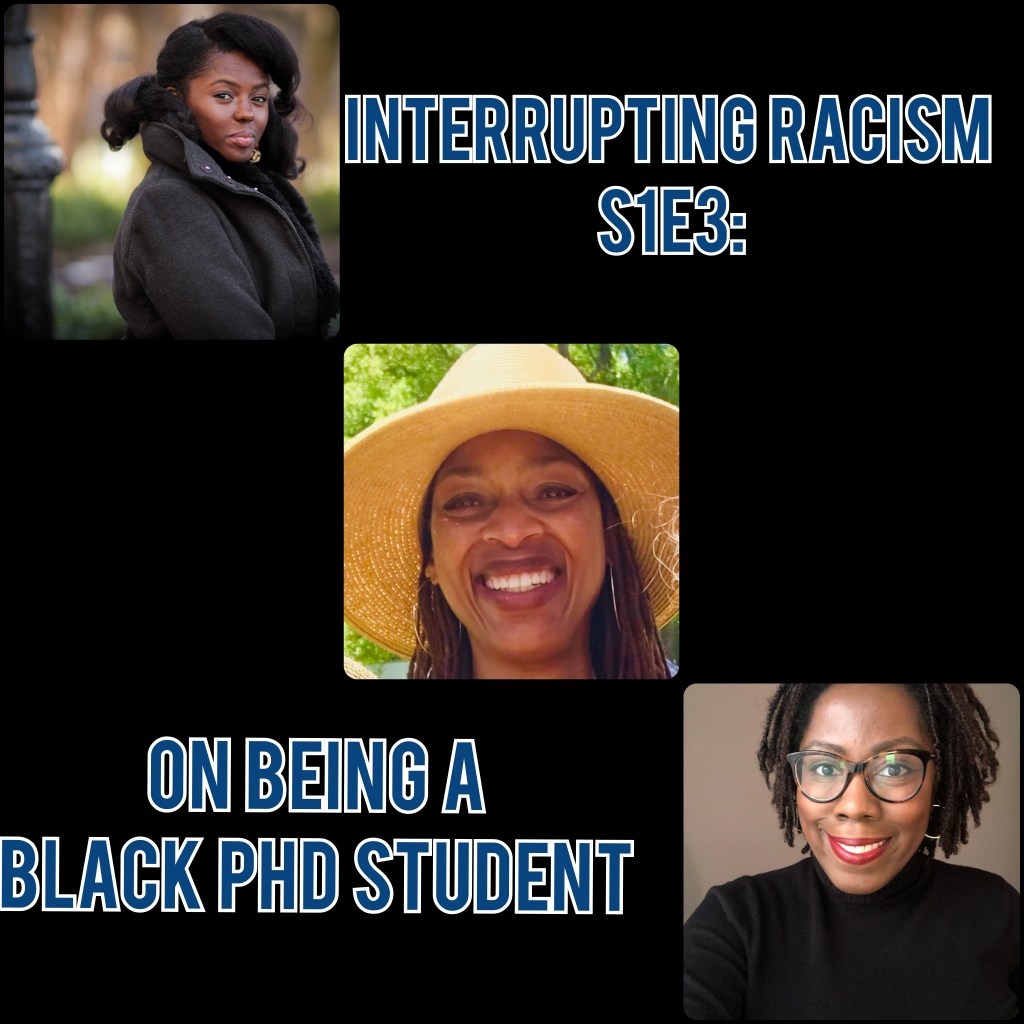
Welcome back. Happy New Year. Thank you for joining me for yet another episode of interrupting racism. I hope you had a wonderful and safe holiday season. Status Quo would have it that white supremacy reigns. People of Color remain in a marginalized status, that black lives and trans lives continue to not matter. heteronormative patriarchy keeps a chokehold on society, the rich get richer, and the poor get poorer until they’ve given up hope repeated toxic patterns for generations ended up in jail, or six feet under everything that we do in opposition to the status quo is interrupting racism. Today, I gather two phenomenal women that I met on my academic journey, who are now currently on their PhD paths. One is a student and one is currently a candidate. I thought it would be interesting to get these two women together to chat about their experiences in higher education as black women. Let’s start the show.
Thank you so much for joining me. I know you both have so much going on, especially at this time of the year coming to a close of the semester. S o I’m really grateful that y’all were able to find this time. Before we get into the conversation. I really wanted to let you all take the time to introduce yourselves to the listeners, kind of tell us a bit about yourself and what you’re up to these days.
Bernetta 1:26
My name is Bernadette parson. I am a PhD candidate. I’m candidate status now, which is great in higher ed (laughs) at Syracuse University. I was an administrator for many years working with students of color, low income students, first generation students supporting their educational journeys at multiple institutions. I worked at community college and also at elite liberal arts colleges. And so that’s one of the things that I’m focusing on in my doctoral research is to figure out faculty attitudes towards community college students, particularly at elite liberal arts colleges, which is something we all know about. It was my journey, it was your journey Alexandria and Kat (laughs). So we all know a little bit something about what it’s like from the student perspective. But there’s not a whole lot of research on the faculty perspective. And that’s what I hope to contribute.
Alexandria 2:36
Yeah, we all know that experience. I would love to see this research (laughter from all speakers). Thank you Bernetta.
Bernetta 2:45
You’re welcome.
Kat 2:48
So that’s awesome. Congrats on the candidacy.
Alexandria & Bernetta 2:50
Woo hoo! (laughs).
Kat 2:52
Every milestone matters. So thank you for inviting me. I’m really happy to be here. It’s great to see familiar faces, especially in a time like this, but we’re not really seeing anyone. I mean, this is really, really awesome. My name is Kat J. Stevens, I am a third year PhD student at the University of Massachusetts Amherst. I’m earning my degree in higher ed. My research interests are largely housed under Academic social justice with pillars connected to access, identity and student success. My research has been done on black immigrants and international students, their racial and ethnic identity formation, black students with disability– disabilities, and black students and community colleges. I’ve earned a bachelor’s from Sarah Lawrence College where I transfer from BMCC. I also earned my Master’s in higher ed from Teachers College, Columbia University. I have worked in academic affairs, student affairs, residential life, admissions, and financial aid as well. So I love talking about students.
Alexandria 3:51
Thank you both. I didn’t even think about all of the similarities in terms of what you all are studying. It’s so dope that you both are able to be here and I can’t wait to hear your perspective on things. I also wanted us to talk a little bit about how we know each other.
Bernetta 4:06
Wow. So I met Alexandria first. And when I was the director of exploring transfer in 2015, right?
Alexandria 4:19
Yeah.
Bernetta 4:20
Yeah. You know, just it was you were a student in the program. And you were such a like a bright light, that when it came time for me to hire counselors, for the next year, I was like definitely she’s on the list.
Alexandria & Bernetta 4:36
(Laughing)
Alexandria 4:39
Thank you!
Bernetta 4:41
…for what was probably the hardest year that we had to go through. So it was really great to have your presence during that year. And then I met Kat through ET, but not as a student. I’m trying to think how exactly did we meet Kat? I remember being on Vassar’s campus. I don’t know if you were visiting someone–
Alexandria 5:05
It might have been graduation. I think it was graduation.
Kat 5:09
Oh!
Bernetta 5:09
Okay.
Alexandria 5:09
And Kat spoke. Kat, I think you spoke at 2015. Yeah, I think you spoke that year.
Bernetta 5:14
Okay. Okay, that said I invited you–
(Everyone laughing)
–and, so which, you know, led to us presenting together on Exploring Transfer?
Kat 5:29
Yes, I all of the years being connected to ET, kind of one big blur to me, but they all like special moments. I remember meeting you, Alex, I’d done exploring transfer in 2011 went back subsequent years to be BMCC. And they would always have like this event for students that were going in the summer and so I met you there. And then I met you again, when you had come back and you were deciding on where to go for your Bachelor’s like where–which 4-year school to transfer to. Bernetta, of course, I know, we were emailing I don’t know, who put us in contact somebody put us in contact.
Bernetta 6:01
Someone did. And I don’t know who.
Kat 6:04
Someone did.
Bernetta 6:04
Yeah. Because I you know, every year at the ET graduation, there is a student speaker there was, you know, faculty speaker, and usually try to bring back an alum. And so someone must have told me about you, someone who had been in the you know, who had been involved in the program. But I don’t know who that, who that was, yeah.
Kat 6:25
I don’t know either. But I’m grateful to them.
Bernetta 6:27
Yeah.
Kat 6:29
And then we just– everything just kind of snowballed from there. So lots of Exploring Transfer connections and community always.
Bernetta 6:37
Can I just say, like, we’re talking about Exploring Transfer, but we haven’t really explained what that is. And so what I would say is that it’s a program that’s been in existence since 1984. So more than 30 years, it started out as a partnership between LaGuardia Community College and Vassar College; and it was to bring promising community college students to the campus to do five week interdisciplinary courses, taught by a Vassar professor and a Community College professor, and really to kind of give community college students a sense of what it would be like to go to a residential college and a more selective college. And so over the years, it’s grown to include 12, maybe, like almost maybe 15, I think, community colleges across the country. So from urban areas, rural areas, there’s also an affiliation with a tribal colleg. I guess, I would say students, and I was a student as well; students who have done the program have gone on to many colleges, Yale University, University of Michigan, University of Southern California, they’ve gone to liberal arts colleges, like we have, Mount Holyoke Smith, Vassar, Sarah Lawrence, Swarthmore, Amherst. So they’ve gone on to a lot of different things. But even if they haven’t done that they’ve at least explored, which is the reason for the program, they’ve explored their different transfer options. And even if they’ve gone on to public schools, having the experience I think, helped people shake their sense of who they are as a student, and as a person.
Alexandria 8:24
Absolutely. Thank you. Bernetta. I think that’s a great explanation of it. I always say that I’m so grateful for that. Because, you know, I was in school, obviously, but I think I was just like, “alright, I’m gonna go back and get a degree, I’m at community college, we’ll start somewhere, we’ll finish out I’ll go to a CUNY”. It really changed the trajectory of what I was doing. And I was working at a job full time at that time, I was managing this optical or co-managing this optical. And then I went that summer. And by week two, I was like, “I’m not doing this anymore. My life is changed, I’m going back, I’m going to quit, I can’t do this. I need to focus on myself. I got to focus on school”. And I did, I went back and I was I had the hard conversation. I was like, I need to give up this title. And this extra money. Not that it was much extra. But I had to give it this extra money. Because I wanted to focus on my education. And I just wouldn’t have had that view of it. If I hadn’t been at Vassar for that Exploring Transfer program. I did go broke for the next two years when it was time for me to go back to Vassar. And I’m just recovering from that, graduated two years ago. But I wouldn’t have changed it. It was everything. And I’m thinking about a memory that I have with Bernetta; just being in your office that day (laughs). Bernetta was having these one-on-ones with all the students and I was so grateful to have this woman who when– you know, when you were in the program, you were about my age, right, at the time?
Bernetta 9:49
I think just slightly younger. Yeah, I was in my mid 20s. But with a child.
Alexandria 9:55
Right, right. And so I felt like Who else can I talk to but Bernetta, who’s been through it literally doing what I’m doing. And then you know, she had like an even extra, you know, component like she had a child. So if she can do this, I can do this. This is somebody that I need to talk to. That was a really important conversation. So I’m always grateful to you for that conversation.
Bernetta 10:14
Oh, thank you. It was my pleasure. And I still remember that conversation.
(Laughter)
Alexandria 10:21
Oh, my goodness. And then Kat, Kat I met you at the at that meeting you talked about and it was just nice to get to know you. So yeah, even before I met Bernetta, I’d met Kat. And then we met again at the end of that summer. And I was just like, wow, we were supposed to meet. So it felt like kismet.
Kat 10:38
Yeah. And then we worked together–
Alexandria 10:41
Yes!
Kat 10:42
–at ET. And then Bernetta, we crossed paths again, because I was working at Barnard. Are you working at Barnard?
Bernetta 10:48
Yes.
Kat 10:49
So right on Broadway, and you know, hubble bubble (laughter)–people doing important work. Yeah. So yeah. I mean-
Bernetta 10:58
That was incredible to me when I was like, what Kat? Like my Kat (laughter)?
Kat 11:05
Yeah, it’s a small world, small, small, small world, and you keep your community and you see people again, and again, I think that’s one of the things that I like took away the most from ET, was just building community and having community for years. My ET cohort from 2011, I’m still tight with a handful of people. We’re still in each other’s lives. It’s just gonna be that way forever. So
Alexandria 11:28
Yeah, it’s an experience if you didn’t go through it, and it’s hard to understand. So we share the bond… Bernetta and I got to work together on a panel last year now just a little bit before this time with the National Women’s Studies Association, at their conference, and we talked about transformative justice in higher education. We were talking about the Exploring Transfer program. I don’t know how many talks y’all go to. But that was my first conference. And I was so excited. Oh, my gosh, I’m at a conference.
(Everyone laughing)
I am speaking at a conference! I have come up in the world!
Kat 12:03
It’s a big deal! It’s really important, it’s a big deal.
Bernetta 12:06
That was a, it was a good one. It was intimate, obviously. But I thought it was really good. I loved hearing– So the director after me, Colette Cann, who is at the University of San Francisco now; she was more familiar with the faculty who taught in her years and invited them, I thought it was really a deep dive into what the program actually does. When you talked about it changing the trajectory of your life. It did that not only for me, but for my daughter too. To have a mother and a young mother, right, go from public assistance to you know, having a degree and being able to live in different places that changed who she could have become to and who she did become. So yeah, I really enjoyed that conference, just because it really kind of laid out the purpose, the original purpose that the co-founders were Dr. Janet Lieberman, and Dr. Colton Johnson. You know, Janet Lieberman was a powerhouse. And she really saw potential, in just about everybody, and she wanted to do that program to change lives. And so I always appreciate that from her too. And I appreciated the chance to talk about that.
Alexandria 12:16
Me too. Yeah…Let’s jump into a segment I’m calling quotes to live by (tranisition music). Are there any quotes that you hold on to, are inspired by, or live by that you can share with others?
Kat 13:44
One that I always go back to strangely enough, came from my time, my first time at Vassar, and it’s literally one that I use all the time. And the person that shared it with me was one of my counselors at the time, when I was in the program. And what they told me was something akin to, “you don’t want to leave here feeling like you didn’t do everything you could do. Give it your best, regardless of the outcome. So you can leave feeling fulfilled”. And so, subsequent years later, what, almost 10 years later, having done that, it’s something that I think about when I want to like kind of do a project halfway, or I want to do my work, but I want to go to bed and I’m like, no, no, no, you have to keep pushing. You really want to know that you did it, and you did it the best you can and then you can walk away feeling good about yourself and what you contributed. So that is definitely something that I learned from ET, or my experience here is just like to keep pushing myself to take appropriate breaks, of course, but also to keep pushing myself to test my own limits, but also like, see what I can do. And that’s something I’ve never forgotten.
Alexandria 14:47
That’s a good one.
Kat 14:48
Because I wanted to give up there are many– (laughs) whew, there are many times ET, which we can probably all attest to of wanting to be like “like this is garbage, what am I doing here?!”. But it gave, it solidified a work ethic in me that I would not have gotten to where I am today, had I not had that summer experience, it just wouldn’t have happened.Ever.
Bernetta 15:07
I agree. Definitely like I mean, it was not meant to be an easy program. But I think the reward is in sticking with it. Right. And I definitely took that lesson. Throughout my career, I took that lesson. So yeah, the quote that I have, I usually will put it like, I’m not working now. But I will put it somewhere that I can see it when I’m working. Because I’ve had some hard work situations. And so the quote is from Helen of Troy Does Countertop Dancing by Margaret Atwood. And it’s, “you think I’m not a goddess, try me”. I love that. It’s always to kind of remind myself of my power, even if it’s a tough situation.
Alexandria 15:57
I like that. And it’s short and sweet. On that same note, y’all are making me think of a quote, and it’s kind of one of those things, you hear it so many times around different places, and it molds and it shifts, but it’s, “if you believe it, you can achieve it”. I think it sounds so corny. It’s so but but it’s so true. Because I think about who I was when I was a child, and how I just I didn’t think about failure. I never thought about failure. Like I would want something I wanted to be in a contest, I just enter it, you know, I never considered like, what if I lost because it’s like, okay, if you lose, you do it again. But I think over time, you get a little bit fearful of failure. And I keep reminding myself to go back to the idea of like, okay, so if you fail, what does that mean? It means nothing like it’s not going to stop you from trying again. So if you believe that you can achieve it, that one gets me by… What was it that drew you to your graduate program? And maybe we already talked about this. And then why do you study what you do? And what are the goals that you have in mind for the track that you’re on?
Kat 16:57
Okay. That’s a big question. I guess my initial response would be the experiences that I had; as a first generation student, as an immigrant student, as low SES student on financial aid, on Pell Grants, you know, as a student that, at times when I was at community college was on was on SNAP benefits, like, as a student that was housing insecure, like all of these experiences. And then of course, being from New York City and having to deal with the subway, and everything, everything, everything, like, all of that, I think is what ultimately has continued to push me to even be at a place where I can comfortably be in graduate studies and doctoral studies. Because I know that, like there are some people that want to do research on underserved populations, and whatever they call them. But once you live that experience, like I have, for me, it’s just a fuel to not only like, highlight our stories, but to humanize us in a way that lets people know that we are more than a statistic, or a certain type of student that people didn’t think would succeed, but also like, we deserve the best. And it is an institution’s responsibility to make sure we have everything we need to succeed. So just my lived experiences of being a student that has had an unlikely side of everything has pushed me toward graduate studies, because I’m stubborn, and I want to find a way. And I’m going to find it. So that’s why I’m here.
Bernetta 18:28
I would say is, so having had a number of director positions professionally, the reason I decided to even do this was because I wanted to have a bigger impact. I was hoping to not just affect the students that were in my orbit, but to be able to affect students on a larger scale. To be honest, it was some internal but also external as well, I wasn’t going to really advance without a degree as a black woman. And I will say that there were white people and white males, who were able to do what I was doing without the degree I already had, right, the masters. And so I knew that I wasn’t going to, you know, move further without the degree.
Alexandria 19:23
So what are some of the biggest challenges or hurdles that are in your way while you’re on this path?
Bernetta 19:29
I was hearing Kat talk about, you know, the experience of having to have SNAP benefits and all of that. I think not being independently wealthy. Means Right, I’ve had to take out loans have gone through my savings, my savings are gone. And I’m back in a position where I have no money again. I’m having to rely on public assistance. And that is really demoralizing, right to have come so far, and to be in the same position. So I would say it’s, again, right, doctoral study wasn’t meant necessarily for people like me. And this is where it comes up.
Alexandria 20:18
Wow.
Kat 20:19
Mmh hmm, mmh hmm. I’m sorry, I just blanked on the question, because I was so focused on what Bernetta was sharing.
Alexandria 20:26
Yeah.
Kat 20:27
I was just like, whoa, yes. Um, honestly, I would say mine are twofold. And I would say the biggest hurdle would be my own self, and recognizing my true ability, which is boundless. However, knowing that and always living in that are two different things. I get in my own way all the time. I get in my own way, all the time. And I really shouldn’t, I really know better. But it’s like, I don’t want to call it imposter syndrome. Because it’s more than that. But it’s a lifelong existence of internalized second guessing myself, even though I have the proof again and again, and I show up again, and again. And I get it done again and again. There’s some kind of cognitive dissonance between me and like, just believing in myself all the way and getting it done. And I think the other part would be financial. Before coming back to community college in 2010, I had a lucrative career. I was working in Corporate America. I just basically had my high school diploma. I was making six figures. I was taking care of family members. I was living a good life, and to go down this pathway of investing in myself by chasing higher education (laughs), I am consistently living paycheck to paycheck. And while I’m blessed to have an assistantship that comes with full tuition remission, and I’m blessed to have certain things. It’s problematic when you’re working around the clock, and you don’t have enough to take care of yourself, to find steady housing. And so it’s like, just constant cycle for me of okay, I’m doing my comps and getting out. I gotta get that done. I’m trying to get done in three semesters. I need to find a job. My funding runs out next semester. What am I gonna do then, you know? So it’s definitely financial, even with all of the funding that I have received, it’s not enough. It’s like not enough to live like a human being. And so that gets me tight. Because I feel like I’m giving everything I have and enough and not being poured back into me. But yet people want the brilliance of me without nourishing me enough so I can get to that place. So that’s kind of stuff pisses me off. But that’s why I study higher ed, so I can contribute to the problems. So, yeah.
Alexandria 22:48
Yeah, rightly so
Kat 22:50
I mean, I’m not in my 20s. I just turned 40. I have other needs. I mean don’t look it (laughter) but, I just turned 40 a few months ago and I am living in a very precarious situation. My stipend is never enough. I don’t have a retirement anymore. I don’t have, you know, 401k anymore. I like have other needs, you know, like I have things to do. And it’s not like I can just call up my parents and say, Oh, do you have a spare apartment that I could just live in while I study? That’s not, that’s not a real thing. So that’s what I would say. And then get on my own basically.
Bernetta 23:27
Yeah, that’s exactly what I mean by this, the system wasn’t meant for people like us. There’s no reason and I’m older than you Kat, there’s no reason that I should be getting public assistance at this point. Trying to get this degree, there’s no reason for that. Except that it wasn’t meant for me.
Kat 23:46
And then and then and make it so competitive, right, with a few of us that there are. And its like, oh, there’s two of you? We’re gonna pit you against each other for this little pittance over here. And then, you know, but I’m gonna keep quiet right now.
Bernetta 24:02
(Everyone laughing) I’m gonna tell the truth on this. (Laughter)
Kat 24:09
It is what it is.
Alexandria 24:10
Yes, I remember when so I messaged Bernetta, and she was like something like, I just want to let you know, I’m not about being politically correct anymore. I’m gonna– And I was like, “Oh, good. Me, either. That’s why I finally started my show”. Because I was always so like, “oh, no, I don’t want to say the wrong things”, and now I’m like, y’all gon treat me poorly either way. I’m gonna say what I have to say
(Laughter)
Kat 24:30
Liberation right?
Alexandria 24:32
Right… What impact do you think that your race has had on your education and your position as a PhD student or a candidate? How has it colored your experience, and there’s no pun intended on that?
Bernetta 24:49
I mean, I you know, when one of the classes that I took on student development, asked us to look at our whole educational journey, right, so from beginning to up until that point. And so just thinking about the public school experience I had, I was a really bright little girl. But I also lived in the projects, right. And so I didn’t have opportunities. I graduated valedictorian from my high school. And it still took me eight and a half years to get to college. I mean, just those opportunities that I didn’t have, because of who I was and where I lived, you know, how much my parents earned? It was all of that kind of acted as barriers, if I had been in the suburbs, if I had been white, if I had had money, who knows? Who knows? I mean, in one way, it could have been really good. And another way, right? I wouldn’t, I wouldn’t have my daughter, right, because I had my daughter at the time when people are graduating from college. So I’m grateful for that. And I wouldn’t change a thing about that. But it’s to show that I did not have opportunities that people who had similar intellect, had.
Alexandria 24:59
Right.
Kat 25:15
I have an answer, but I need to figure out how to say this. I think for me, it’s not so much about race, it’s more about class. And it’s more about other things. I wouldn’t say that race for me has had like that kind of an impact. Culturally speaking, as an immigrant, as a black person from abroad, race is not something that I tend to go towards first, or tends to be something that is part of my composite of this of why this happened, or this is the thing I can pull from. I know it exists. I know there are racial tensions and racism, all that, but it’s never really been the thing for me. For me, it’s probably more class. The immigrant experience, and kind of learning how to exist in a society that racializes everything you do, when you don’t really consider race at all. And so for me, it’s other people’s perceptions of myself, or what they think all of me and my culture is; being Afro Caribbean being Afro Guyanese, I think that people perceptions, but I don’t think my race has impacted me. Probably the only thing I would say, being younger, secondary education, and not being tested for disabilities not being– like, yes, I was put in all these gifted classes. I was tracked for special education in that way. But I wasn’t also tracked for the support that I needed with all the other black kids in my school that were poor in Brooklyn. We didn’t get that kind of help. It was either you were put in gifted classes, or you were tracked for special ed in another direction, that kind of like locked you in and trapped you couldn’t ever break out of it. But those of us that needed additional support didn’t get that. I think that was probably a function of living in Brooklyn and being poor and living in the projects. And then after we got out of the project, I think it became more of a class thing. I don’t know about the race thing. And that’s something that I’m becoming more comfortable talking about, as a person, everybody expects to be able to speak about race in a certain way. That’s not my lived experience. And so I have to honor what my lived experience is. So yeah, that’s kind of where I sit right now.
Alexandria 28:12
Thank you. I think Kat that’s really fair. Yeah, I didn’t immigrate to this country. And I would imagine it’s a different experience when you come from a country where race isn’t as prevalent, like, people aren’t comparing you to white people, because I don’t think there’s a large population of white people in Guyana. So–
Kat 28:29
Uh, no,
Alexandria 28:31
Yeah.
Kat 28:31
I mean, they’re going there now because of oil that was just found. But that’s a whole different story. But no, everybody looks like, looks like me, for the most part.
Alexandria 28:40
Right… So what have been some of the saving graces? What keeps you going or who keeps you going?
Bernetta 28:47
For me, it’s the students that I’ve met, that were in my program and, in other programs, to have that community. That’s literally probably the only thing that’s kept me going. They understand the pain of it (laughs). They just they get it, right. We were talking about, people don’t understand Exploring Transfer, unless they’ve been through it. People don’t understand that the doctoral process unless they have gone through it. And it’s really not easy. If I didn’t have them to complain to or you know, to sometimes be the cheerleader for it would be really hard.
Kat 29:29
I feel like I have so many positive things in my experience. And I think what helped to keep me grounded or like being a person of some sort of faith whether thats Judeo-Christian religion, whether it’s being spiritual. I’m the first person in my family to be on this PhD journey. So at times while it’s a pressure builds feeling, I also have an immense sense of pride about it. So that’s sometimes keep me going. My nieces and nephews are constantly Looking at what I’m doing, so that also makes me I mean, there’s pressure. But there’s also like, okay, just as fun like, like they can see like it can be done. And I’m literally changing the narrative in this generation right now. I would also say, I try to find the joy in just being brilliant, because I’m brilliant. So, and that’s what it is. But I find the joy in like learning and I love to learn, and that brings me happiness and joy, when I get away from the nonsense of “is my check, gonna cover my, you know, my bills this week”, or whatever. And I can just block that noise out and be able to study and write and read, that is the thing that affirms me and make my heart leap. Because I am really a nerd. So if I can get close to that, I’m good. And that keeps me going. And community likes all about community for me.
Alexandria 30:47
So knowing what you know, now, what advice would you give to your past self as they embarked on this journey?
(Everyone laughing)
Bernetta 30:54
Uh, okay. I think I thought about this question the most (laughter). So I would say, do as much research as you can, on your program, ask questions, like, how long does it take? What is the average time for someone to complete? What–Alright, so I would say, one of the things was, I didn’t know–I knew to ask questions, but I didn’t know what kinds of questions to ask. And that’s the more important thing. Anything that you can find on the website is fine. That’s, you know, but you don’t know if students are graduating, or how long it takes them to graduate? Are they dropping out? What professors are the most supportive? What professors will have your back, you need to know all of that, right? Because your life is in their hands, like your life is just in their hands. And so you have to know who they are. I would say, don’t be afraid to ask questions of faculty. Once you’re in that program, you don’t have much control, but you do have control going into it. So ask the difficult questions. Really, like, you need to find out how other students are doing talk to other students, and really ask them to be honest with you. You don’t want to kind of go in blind. If you don’t know what questions to ask, ask students. What questions should I ask, you know. But, but definitely, you have to get to the nitty gritty.
Kat 32:38
I’d say what I tell myself is it’s not you it’s them. That’s what I would tell myself. It’s not you. It’s them. It’s not you, it’s them.
(Laughing)
Kat 32:51
Let that burden go. I know it sounds funny, but I would really tell myself, it’s not you, it’s them. Because for me, how that has shown up in my doctoral journey has been crippling has been debilitating in consistently trying to level up against myself and unattainable perfection that does not exist, because I’m stubborn, because I like to work because I love to work; I’ll just keep going. And nobody will tell me to stop. Because I’m still producing, I’m still turning in what I need to turn in. And people won’t check on me and be like, we need to ask, do you need to stop, you’re doing too much. And so I think “it’s not you, it’s them” means for me that I don’t have to, I don’t have to take in other people’s assessment of what this needs to be for me. And this is where I’ve come to now in year three, is that where I was in year one was so green, so green. And now I’m like, I know, I don’t know, if we can come on here or not (laughter). But I don’t really give a blank, I’m gonna do what I gotta do, I’ma do what I got to do to get ready to get and I’m going to play the game. But I also know that this is my journey, and I am the captain of the ship. And I get to say, who stays who goes, who’s on my committee who’s not. And that took a while for me to get there. So instead of me continuing to suffer needlessly under other people’s perception of what your PhD journey should be, because somebody tortured them when they were a student, therefore, they’re going to torture you when you’re their student. That doesn’t have to be my story. And it you know, that’s why I am now it’s like, I’m gonna get there to the end, and I’m gonna finish, but it’s not my burden to carry what other people want to make me. I’m going to get there regardless. I’m blessed anyway. So however it looks how it looks. And yeah, it’s not me. It’s them. That’s it.
(Laughter)
Bernetta 34:42
And I’d also add one other thing is because you mentioned about you’re a perfectionist, and you do like to work hard, I would say also, I I think in my first semester one of my professors said to me, “you know, the best paper is a done paper”. And that sounded like it was lazy to me (laughter). I get it (laughter). I get it now, I don’t have to be perfect. And I think that was always my mentality in school was being perfect and getting A’s and like, nope, the best papers I’ve done paper.
Kat 35:22
Hello! What I will also add to that is I’ve been struggling in so many ways with I don’t know fierce increases of difficulty doing my work. From midway through my master’s program to my doctoral studies. It wasn’t until year two know your one two end of year one that I got diagnosed with my different learning disabilities and disabilities, whatever in general. I had been working that much harder and feeling like I was always dropping the ball. Meanwhile, nobody would ever know how much I was doing to actually just stay afloat, and to be competitive, whatever that means. So giving myself grace, and knowing that I’ve been working with less, and doing more, is where I’m at right now. Because like, it doesn’t matter, whatever. It’s gonna happen, I’m gonna finish and move on. I live my life. That’s it.
Alexandria 36:10
I think that it’s relatable. It’s something I used to always think about when I was in school, that perfectionism, all it did was just give me lots of anxiety. When I look back on my time, at school, I feel like I missed out a lot on just enjoying moments. Because I was more focused on like, “I don’t have time to sit here with you guys and laugh, I got a study, I don’t have time to do this. I got it–“. And it’s just unhealthy. Yeah… Now it’s time for the recommendation of the week.(Transition music) So every episode, I have a segment called Recommendation of the Week where my guests and I suggest a powerful body of work for others to engage with, be it a book, a film, series, a documentary, or album, whatever. And so this week’s Recommendation of the Week is brought to you by my guests, Bernetta and Kat, ladies, please hit us with the recs.
Bernetta 37:04
One of the things that I’ve just recently actually come across, it’s a group of Black, either students or candidates in my program. And we had a discussion in the summer that’s centered on Black Feminist thought. It was, I think, Patricia, Patricia Hill Collins. And that has been really important. It’s not a theory that I’m going to use in my own work. But I think just as a Black woman in the academy, and knowing that, what our knowledge isn’t necessarily centered, right for myself to be able to do that, and, you know, be able to move forward is really important. And so I take from that I take from those principles. And so I would, I would suggest that some of it is a little philosophical, but I think it’s really important to put it in practice, like, what does this mean to center your own knowledge? Even if it’s not going to be valued? Alright, so yeah, I would say the whole dissertation process is not, it does not align with Black Feminist thought (laughter). So, so I think it’s really important to, to ground yourself in that and be able to move on gain strength from that. Goes back to “you think I’m not a goddess, try me”.
Alexandria 37:49
Right.
Kat 37:54
My recommendations, I would say, for me, at this point, everything kind of intertwined. Intentionally intertwined with my own personal growth, owm spiritual growth, and constantly reminding myself to connect it back to me, connect it back to my ancestors, connect it back to the gifts that were given to me even before I was born; the gift that my parents continued to nurture when I was coming up. And so for me, my recommendations are whatever you would have that would allow you to look back at wherever your people come from, whatever your heritage or lineage may have given to you. And so like for me right now, like, I’m on a whole journey, and I’m doing a whole thing that’s important for me, but I listen–I spend a lot of time listening to like old Bob Marley, like all Bob Marley, basically. I spend a bit of time listening to this artist, just like several albums, her name is Saroc, S-a-r-o-c. Another artist that I listen to like, what is this woman’s name?–Jah9. So, I still I spend a lot of time listening to music and just surrounding myself with art and music videos that allow me to be rooted and grounded in thinking outside of myself and spiritually connected to like Afro Caribbean folklore or ways of being, mechanisms that just keep me tied to like, where my people came from and where what we’ve been through. So for me, I spend a lot of time just– like my recommendation would be whatever grounds you. Whatever kind of art form grounds you in that, for me, it’s like, mostly music, and keeping me like, in a vibe all the time.
Alexandria 40:28
Thank you. So how has being a graduate student affected your personal relationships?
Kat 40:35
(Sarcastic laugh) I would say, I don’t know how it’s affected my personal relationships. But I’ll say that it’s helped me to continue to pour into my most important personal relationship, which is was myself. At the time overlapping my masters, up until like, literally started my PhD program, I was dating, married, divorced, moving from state to state. That’s one thing. And so going through all of that, while finishing an intense master’s degree, I had to really, really, really, really learn to also continue to depend on myself, and that whatever I want to make from personal relationships could or couldn’t be there. But at the end of the day, it was me, it was my schoolwork, and it was degrees that I was committed to and nobody could take that from me. Yeah, well, I think about that, when I think about, like, how it impacted relationships. It just helped me to focus on what I want, and what I don’t want, and what’s important, what’s not important, just getting the most out the way.
Bernetta 41:33
I think, for me, it was hard in some ways, because I think the process itself can be very isolating, because it’s you and your research. And I didn’t like that. I didn’t like the idea of that, you know, I had to move first of all, from you know, where I was living. My daughter and I had routines, we would do Sunday brunch, like every other week and or have dinner. And so that was hard. And I couldn’t maintain that. Right while I was away. So that was hard. I think that personal relationships are what sustain you. And so when you can’t do that, it makes the process that much harder. It was hard. But I did make community in Syracuse. I would have parties every now and then. I think I had three parties in the three years that I was there, because I needed that students needed that. One of the other things that we did, you know, I helped co-found–Oh, you you all know Kim Williams?
Alexandria 42:41
Yes.
Kat 42:42
Mmh hmm.
Bernetta 42:42
Yeah, so we co-founded a graduate student organization where we had writing sessions, write-a-thons so that people had some kind of community, it’s impossible to do this by yourself, unless you want to lose your mind (laughter). It’s just impossible. And so to have that outlet. I remember one of my friends, she was also a GA, she got married, and I was struggling with oh my god, do I go to this wedding when I know I have all these papers to do. And I went and it actually made me feel so much better. And I was able to get much more work done because of it. So I needed the personal relationships.
Alexandria 43:34
Thank you… I want to know, how are you all coping during the pandemic because that has affected people’s lives in many different ways. I’m grateful that I don’t have to be a student during this time. So I’m wondering how that’s affecting you on a personal level, on a academic level.
Bernetta 43:50
I mean, I always say like, you know, 2020 has been the year of all this stuff happening, pandemic first. But my 2020 started in 2019 when I had this accident, and I couldn’t go out anyway, I couldn’t walk. And so I was bedridden, and just trying to deal with healing physically, you know, around March when everybody had to kind of lay low, I was like “wow, the world kind of has caught up with what I had to deal with”. So it didn’t affect me, as I think horrifically as it has affected other people except for trying to find a job in this time is hard.
Kat 44:34
I share that…This is also kind of unpopular, but this year I’ve had plenty of challenges for me personally and academically. But I’ve also had plenty of wins at the same time. And I think I’ve been able to push myself to make the most of it, but also go deeper into my own shell of who I am and what makes me happy. I’m an introvert I like being alone. I really enjoy just being by myself anyway, I really just like my own company. So just is obviously terrible, horrific, painful. But I also have been able to just be the fullest version of me that I am anyway, without hesitation during this year. I just came back six weeks ago, actually from being in Mexico. I was in Mexico for three months and didn’t think I was going to come back to the US to be quite honest, I wasn’t planning on coming back to the US. But I came back and going there for those three months, and just bringing a suitcase of clothes and a suitcase of books with the most liberating things that I have done in a long time, and just solidified to me that I’m going to do this PhD on my own terms going forward. And that’s it. I mean, it’s impacted me academically in the sense that I finished coursework last semester. I was TA-ing this semester, everything’s on Zoom, you know, which is a bit of a headache. But I think as far as my milestones, it’s kind of impacted my comps a little bit. My comps are taken a little bit longer. My goal was to have them done this semester, it’s not happened. Everybody’s exhausted. Faculty are going through it, students are going through it, the staff is going through it. And I’m going to have to wait until next semester to do it, which is not the end of the world, but I worked so hard to get to this point and now I just have to wait. It’s difficult in the sense of like, I’m not going home, I’m not in New York, I won’t see my family for a while. Most of my family are essential workers. And I’m not going back to New York City anytime soon. So, you know, it’s it’s hard to be away from family when you want to be near family. But I also know it’s just better for everybody for me to stay in one place and be done with it. So yeah, that’s what I think about with COVID like the inconveniences and the challenges, but it’s also been a very restoring time for me, personally.
Alexandria 46:44
Yeah, I was talking to Bernetta before you got on the line Kat. And I was just saying that my contract finished with this job. And then I couldn’t find another job. And I was just trying to lean into like, well, this is so you can do all your creative things, which I’m always putting on hold because I’m working someone else’s job and pushing toward their goals. And I finally had this time to work on my writing and to work on this podcast that I’ve had literally lined up for the last three years and imposter syndrome gotten in the way and being afraid to say what I want to say got in the way. And then finally I was like, I’m going to do this. And I’ve been having so much fun working on it, and reaching out to different people to talk about these different topics. This is really what I love. So yeah, the pandemic has been kind of restoring, obviously, there’s lots of sad things that have happened for people all over but the positive is that I’ve been able to kind of look in and not feel bad about being on pause. Like Bernetta was saying, you know, she was stuck in the house from 2019. And it’s, it’s not like a misery loves company thing. But it’s kind of like the pressure of feeling like, everyone else is running at full speed. And I’m paused, it kind of takes a little bit of pressure off and you’re like, it’s okay, that you don’t have a job right now. Because a lot of people don’t have a job right now, like you’re not doing something different. It gives me a little bit of peace to know that everyone’s kind of a little bit slowed. Um, anything you’re currently working on any projects coming up, or any recently released things.
Bernetta 48:10
You know, as we were saying, I think I’m going to lean into more creative things. I just finished a podcasting class. And I think that would be a really nice, I guess, way to channel some of my energy. But one of the things that I’ve wanted to do, and maybe you all can help me with this, but I would love to get ET voices in a podcast. I don’t think that program is going to be what it was. And it would be nice to just hear the impact of the program for people and different memories, right? I went in the 90s. And you all have gone in the past decade. So just to hear from the professor’s what their experience was like, that’s one thing that I would love to do. You know, you’ll get an email from me soon (laughter) about that. I also am doing my dissertation proposal now. And yeah, it’s really hard and I’ve got to do that by the end of the year and submit it to my committee. I have my first committee meeting on January 22. So that’s really exciting. For so long. It’s felt like this process has been stalled. And now it’s finally moving another step. So I’m really excited about that. And yeah, I mean, those are probably the two main things.
Kat 49:44
Very cool, very cool. Well, I’m happy to lend any support or whatever, always down to talk about ET, always, always, always. I would say for me, I’m in this gray area of working on my comp right now. I’d been Working on them unofficially working, not working, whatever. But because you know, my university has ended fall 2020 semester early, and it’s starting spring 21′ later, there is now this huge break, which means that I have to wait longer to defend my comps which is, you know, in the grand scheme of things, it’ll be fine. It’ll be done in February. But that’s happening. So I’m working on those papers. And I also have to do my proposal; have to do, want to do, will do my proposal by the end of spring 21′ semester. So that’s coming up the pike, though getting those two milestones of out of the way will free me up a lot. So I’m looking forward to that. Creatively, I’ve been kind of putting my foot back out there again, because I’ve been a creative person, probably, as long as I’ve been a kind of bookworm person. So I started my YouTube channel, again. I’m launching a space for people to talk about the joy that they find in their academic pursuits. Because so much of what I find is people coming together to complain about all of the terrible things that we know exist (laughter). The structures that are not, were not necessarily made with us in mind, or to succeed or to invite us in and want to kind of push back against that narrative. And so I’m going to be launching a space for January of 21, for people really just to like, come together and share whatever is positive about their own self development, or themselves as a person outside of the thing that they do, which is whatever they do in the academy. So that will be launching soon. And I’m continuing to take clients for for coffee and academic coaching just on my own, because I think there’s enough that people don’t know, especially folks that don’t have people that have gone to school, in their family. If you don’t know what you’re getting into, you need somebody there to be by your side and help you creatively problem solve. So that’s kind of what I’m getting into on my own. And just helping Caribbean scholars find each other and boost each other’s work so that we can continue to do work on the region, and people from the region, outside of the region, inside the region. So those are my creative endeavors.
Alexandria 52:01
That is dope. So glad I actually I’ll have a lot going on. And you know, I’m definitely here to support in any way that I can. I will have you all send me information. If there’s any links or anything you want me to drop in. I’ll put that in the description so that people can look to that. Yeah. So are there any shout outs to any mentors, or any loved ones or anyone who’s helped you on this journey? Sometimes I think, you know, I leave those people out. And this is a huge list of people. But I don’t know if there’s anybody you wanted to name.
Kat 52:30
Lots of people clearly like my family, my friends. I have a small group of scolar mom, friends, even though like, I’m not a mom, but we continue to find each other because we’re all like late 30s-40s, whatever. And so we support each other in different ways, in a number of ways, but especially around having these outlier, quote unquote identities while being PhD students as well. So them, for sure. I have a long standing group text from maybe 4 years now of like, some folks from my master’s program and we’re all dragging along right now through proposal and all of that stuff. And my internet friends (laughs). Because sometimes just going on social and laughing at something ridiculous is what you need.
Bernetta 53:16
I would say that the people that were GAs with me, those were the ones– I still am consistently in touch with them. And sometimes it will be to complain, or to be like, “oh my goodness, I can’t believe it’s taking this long”, or “I’m worried about comps” or you know, whatever it was at whatever stage, but also just to share the good stuff, too. So this is Kelly and Shannon. And both of them have children, both of them have gotten married, just to share that joy. That’s important too, and to get to know each other outside of the academics. Right. So I would say I probably rely on them the most, but there are other people too. You know, Kim is one who’s just been really wonderful. And there are others. But I would say it’s a small group. Sometimes I think it’s hard to have a bigger group that’s small but really powerful.
Alexandria 54:18
Thank you… (Transition music) I’ve decided to ask each of my guests. What does interrupting racism mean to you? How would you define it? What does it look like? I’d love to hear what you think.
Bernetta 54:33
Yeah, I think this summer with all of the protests and you know, the attention being on racism that people seemed really surprised existed.
(Laughter)
Bernetta 54:54
I think what it made me realize was, I need to say you know, whatever, when it comes up like that I don’t need to be polite anymore. Or I shouldn’t say that. I don’t need to be tactful anymore. Like, I can call the thing what it is. And I think for so long, you know, you have the “angry Black woman” stereotype. And you know, if you say something, then people are going to get their noses out of joint. And what, what this summer made me realize was; no, you have to say it, because I think people, some people genuinely are not aware. And so by saying it, you’re hopefully moving them to a space where they can understand, see, empathize, whatever. The– like you’re helping them right, when you say it.
Kat 55:55
I don’t know that I’m trying to interrupt racism. I don’t think it’s part of my plan for myself, I don’t think it’s part of my ability, or the part of my goal. I’m trying to interrupt, like, the staleness. I’m trying to interrupt people being mediocre. I’m trying to interrupt limitations that are placed on us and how we perceive ourselves in the world, and how we move through with joy and happiness. And that we may get stuck in because of somebody else’s programming. I’m like not interrupting racism. I’m just like, Okay, it’s there. But I don’t care enough to move in that in that wavelength. So for me, I would say, I’m trying to get people to find their joy and happiness, and whatever that looks like. Chase that and be the best you can be. Instead of– I feel like there was somebody, maybe it was Malcolm X. I don’t know who said it. But, I feel like it’s come up again and again more recently like, sometimes these actions, these other experiences in the world that we live in, can be made distractions to keep you from doing what you need to do to keep you from being your best self to keep you from contributing to a world that you deserve to be in. And I know also, Toni Morrison said something about racism being a distraction, but I’m gonna mess it up. So I’m sorry if y’all can Google it, you’ll find it. Mother Morrison said that, but yeah, I’m not. I feel like for me, personally, interrupting racism is a waste of my energy and time, because it’s going to exist, whether I fight it or not. So I’m trying to pivot my energy elsewhere.
Bernetta 57:25
Yeah, I can appreciate exactly what you’re saying. Because I think like, for me, that has been, like my mindset. Like, you know, it does exist, like, and I don’t know, you know, if you study CRT, right, there’s the sense like, it’s always gonna be here, whatever. You know, I think, I can’t not say something now. That, I think is that thing for me. And without it kind of interrupting, like, where I want to go. Right? Like, I’m not going to be the person– like it’s not going to be my life. But if it comes to me, like if I see it in my face, I don’t know, now that I cannot say something. And I don’t have to battle. I don’t have to hide from it. But to not acknowledge that like, if something is happening is wrong, I can’t do that now. Yeah.
Alexandria 58:22
You know, yeah, I feel the same way Bernetta. I think, like I’ve said it a few times already. I didn’t realize it until the recent years, maybe like the last five years that I was very caught up in respectability politics. You know, not to the extent of like, pull yourself up by your bootstraps, but more of just like, well, I don’t want to, you know, be a part of these, like “angry Black woman” tropes. So I just, I won’t be angry, and I’ll keep my anger to myself, or I’ll tell my friends and I won’t say what–you know. And, you know, sometimes the shadow part of me spilled out and I did say the things that I wanted, but it was because like it had built up and I wasn’t–I feel like yeah, I just can’t let it pile on anymore. Like if it’s there, I need to call it out. But, I think it’s interesting Kat because I do agree with you as well, right? Like, it is not necessarily my job to educate people and to say, “I’m gonna stop racism single handedly!”. But I think that I’m trying to look at like all the things that you said for me, are examples of interrupting racism because it is supposed to be a distraction. It’s this like, overarching theme that’s always there. But we said “okay, so you made these schools for white, wealthy people, and I’m gonna still attend and watch me do it!”. And so like all of those things, I think are interrupting racism because they never intend for–for you all to be PhD candidates. It wasn’t set up that way and they’re not willing to change anything about it for you to– for you–you just have to like wiggle your way in there. So I think that yeah, living your life and saying despite whatever it is–that like barriers ya’ll want to put in front of me, I’m gonna keep going. I think that’s an interruption but I do hear you on the energy of like, it’s not my job to– to do that. So I definitely hear both.
Bernetta 58:25
Absolutely.
Kat 58:28
Yeah.
Bernetta 58:29
Yeah, I don’t think– you know, it’s so funny one year before Exploring Transfer happened, there was a conference at Vassar and a professor from Smith, I don’t remember his name, he spoke. And what he he talked about was, he saw so many of the Black students put their energy into fighting the racism that was on the campus that their grades suffered. And he was wanting to say like, “No, this is not your job, your job is to be the best student that you can be”. And so the energy level, it can’t be more than the joy level, right? That- that the pursuit of happiness is interrupting racism,
Alexandria 1:00:54
Yup!
Bernetta 1:00:55
Right? Because, yeah, because we were not necessarily, you know, offered that. And in many ways in this country, and still, in many ways.
Kat 1:01:06
I mean. I agree as well. And you know, I’m making swift departure from my social justice warrior past of being on the front lines, and being at every rally and being– like it’s not something I’m interested in doing anymore.
Bernetta 1:01:22
Yeah.
Kat 1:01:23
I’ve done it all through my 20s. And my 30s. And I’m like, No, I’m good. Like, I know, health ramifications. I know my body will respond differently now. I know I want to start a family you know, soon. I’m so like its just a certain environment that I can’t allow to break into my energy in my spirit. And so I have to be very, very careful. And what I’m doing with that energy and former attention these days, I’m spending it to like, what can I do to develop things for Black people in the diaspora, that we maybe have lost some connection with; our own history, our own past, the strengths that we have, things that are ours that we want to share with people? And how do we continue to build those spaces for ourselves, wherever, whether you’re African, African American, Afro Caribbean, like, what can we do to pour into that and to build our own institutions? And that’s what I’m more energized by. So that’s where my energy is going.
Bernetta 1:02:16
Love it.
Kat 1:02:17
But I’m really like, I’m not I’m not about this life. Like, I’m good. I’m digressing (laughter). I don’t have it, I don’t have it. I’m digressing. It’s not cute for me. I’m 40. And I don’t want to be bothered. I just want to be like, I’m Kat and I don’t have to be anything anybody wants me to be. I don’t have to be on the frontlines doing this kind of work. It wasn’t–I didn’t create the problem. So I’m good. I just want to be brilliant and do my work. And I think that’s something we take for granted. And people expect us to fall into that trap.
Bernetta 1:02:50
And you know, what, I wanted to just touch base with you, cat. Yeah, you know, one of the things that that happened, you know I worked at (didacted), and I left, I left (didacted)? Because it was the level of work–Here’s another thing, right? For a black woman, is incredible, right? You know, the work itself, and the the emotional labor of it, right? Because you’re expected to take care of everybody. And so I left one because of that I gotten sick and just wasn’t getting better. And I was like, this job is going to kill me. But the other part of leaving was to get this dissertation proposal done. And you know, in April–
Kat 1:03:39
(didacted–a collegeaue they are both familiar with)
Bernetta 1:03:41
Yes.
Kat 1:03:42
I mean–
Bernetta 1:03:43
She died.
Kat 1:03:44
I mean–
Bernetta 1:03:45
She’s young, right? She’s young, she was only 36 years old.
Alexandria 1:03:50
Oh my goodness!
Kat 1:03:50
Yeah, that was umm–(didacted) I don’t even have words (didacted name) worked for a while, but also worked everywhere else, and impacted so many people and was just continuing to be on a trajectory. And then I don’t–yes, so that hit a lot of people hard.
Bernetta 1:04:06
Well, and you know, because I think here is a young black woman who was doing a lot, like a lot was put on her plate. And I think–
Kat 1:04:19
Too much.
Bernetta 1:04:19
–yes, you know, I think that she took that on to be–you know, she had ambition. Right? But it was way too much. And, you know, I talked to (didacted name) —
Kat 1:04:33
Yeah.
Bernetta 1:04:33
–and he thought that it was COVID. Right?
Alexandria 1:04:37
Oh gosh
Bernetta 1:04:37
That did it. You know, and I think she had some underlying things. But when on top of the amount of work that she had to do, and her underlying, I’m like, it was shameful to me that they put that much on her.
Kat 1:04:55
Yeah, I mean, she was my boss at (didacted job location)
Bernetta 1:04:57
Yeah, I know.
Kat 1:04:58
–before and then I left and like I knew her when she just came to New York and was like oh, “TA and possibly going to be a you know, a lecturer at (didacted location) in our Higher Ed program. And one of our professors had brought her in to like guest speak to the class. And she was just so dynamic and took me out to lunch several times as a broke master student, like you’d have to do any of that. And then offered me a job at (didacted location) like, I mean, that hit a lot of people hard, and it’s one of those things I will never forget. Like her energy, but also the way that the Academy will do us.
Bernetta 1:05:33
Yes. Yes.
Kat 1:05:34
Especially black women. Yes, I’m good. I like like, I like I know what it’s like, to be sick and to be bedridden while earning a master’s degree like that would mean two semesters at Teacher’s College. And then going through a divorce and all the mess, I’m good. I’m good. I’m gonna get these little paper because I already put so much time into it. And I’m a dip. And if I never even use this PhD for what I intended to use it for, that’s fine, too. I come too far to quit. But I mean, I may not even use this degree for what I thought I wanted to. And that’s okay, too.
Bernetta 1:06:09
Yeah. I’m not quite at that point that it’s okay. But I get it. Like, I’m probably not going to. Yeah.
Kat 1:06:17
Yeah. And I’m like, Okay, what did liberation look like for me?
Bernetta 1:06:20
Exactly! Yeah.
Kat 1:06:21
And that’s where I’m at. And I’m like, okay, the PhD is cute (laughter) but, I wanna start my own business. You know start my business like do my own thing, be in charge of my own life so I could continue to have a life.
Bernetta 1:06:33
Yes.
Kat 1:06:33
Because for 10 years this has been my life and I don’t want to be like “Oh”– my whole 30s has been school. I’m good. I just need to get this done and move on. So thinking about a situation especially, like (didacted name of colleague who passed) broke a lot of people in our field in particular, which is notorious for chewing this up and putting us out.
Bernetta 1:06:55
Yes.
Kat 1:06:56
And I don’t want them part of it.
Bernetta 1:06:58
Yeah, neither do I. Neither do I. I don’t think I should never ever do that again. To be worked like a mule, nope.
Kat 1:07:07
Mmh mmh, nope.
Bernetta 1:07:08
Yeah. But I just I wanted to acknowledge that because I remember seeing on Facebook that you posted about that and yeah, it was hard, hard to see.
Kat 1:07:18
Too hard. And so these are the things I think about and this is why– I know I–you know, we’re closing this up but I also like– you know, just why went to Mexico in a pandemic.
Bernetta 1:07:28
Yeah.
Kat 1:07:30
For three months and said, “Dueces!” (laughter) “Catch me on Zoom”. I’m doing my work. I’m meeting my deadlines. Mind your business, because I deserve to have some type of a life. I don’t have to stay in this country and deal with all the onslaught of everything.
Bernetta 1:07:43
Yes.
Kat 1:07:44
And I left and it was necessary because I think I probably would have lost my mind.
Bernetta 1:07:48
Yeah, I get it. I get it.
Kat 1:07:49
I had to go. I bought a ticket and got on a plane six days later.
Yeah. Good for you.
So we had to do we got to do and I’m here. I’m here like, I’m serious. I’m here. I’m around. You know, this-this PhD journey is not for the faint of heart. And so you’re not alone. You got community. I know you already have community, but you got extra.
Bernetta 1:08:12
Yes, yes.
Kat 1:08:13
And to think I used to be like “Bernetta! I wanna do a PhD, help me, help me, help me! I wanna be in a program, I wanna do this–” (laughter) now I’m just like, you people can kiss my grits!
(Laughter)
You know, I was green, and I’m not that green anymore.
Bernetta 1:08:32
Yeah. I mean–
Kat 1:08:33
I was that person–
Bernetta 1:08:34
I get it–
Kat 1:08:34
–and I’m not that person anymore.
Bernetta 1:08:35
I get it. I’m not either. I’m not either. Yeah.
Kat 1:08:41
Alex, if you ever decide to do it–
Alexandria 1:08:43
–it’s on my– it’s something I’m thinking about. But I’m like, you know, I know hmm–I will definitely come to y’all when I when I’m actually seriously think about that path. But I want to do an MFA in probably acting and maybe also one in directing. But when I left school–like after those two years at Vassar, I was like, “oh no”, I need a break from academia. I might literally harm someone physically, because I just– it was overwhelming like the disrespect, just the the nastiness, like just– and so I don’t know if I’m ready to go back to higher education, because I don’t know if I have healed from that experience enough yet.
You know, one of the things I think your experience for me as a director of that program was really hard. I, and this is where I think I would not be so tactful. I would probably be more explicit now. And saying what I think–
–but you know, I appreciate that but I think I think I was lucky because I had I had you and I had a few other professors who are like I really look to for their advice. And there was one professor in particular and he’s a professor of color. And he, he was like, “let me tell you something, you’re going to experience Hell, when you get there, it’s not going to be pretty. You’re not going to love every moment of it. He’s like, but it’s two years of Hell. And then you can put it behind you. He’s like, it’s a small blip in time”. Like, he pretty much told me what I was going into. And I was like, “okay”. So I had like, different people’s like perspective. But I wouldn’t change it actually. Because I feel like my senior thesis, I wrote it because of the experiences that I had. And it’s–I think, a really good body of work. And I feel like, you know, it’s okay. Like, I was meant to experience that so that I could write this play. If nothing else, it was to do that. So I don’t regret it. But I do hear there’s a difference in the way I approach telling people things like, I’m just more real about it. Now. I’m tired of being tired of placating people. I’m tired of being politically correct. It’s just it’s because it gets us nowhere. It gets us nowhere,
Bernetta 1:10:58
Right. Exactly.
Kat 1:11:01
Yeah, no, I yeah, I didn’t have that kind of warning when I went to Sarah Lawrence. I hadn’t, I didn’t have any. I just got there and moved on campus. And that was it. And I had a life changing experience, for good and for bad. I wouldn’t change it, I would never change it.
Alexandria 1:11:17
I want to thank you both for joining me. This was definitely a fruitful conversation, a fun conversation. I miss you all so much, you know, being in person. Hopefully this is all over sooner than later. I feel nourished. And blessed.
Bernetta 1:11:33
Me too. Thank you to you. I–this was a thing I didn’t know I needed (laughter). So thank you.
Kat 1:11:42
Yeah, I’m just very happy to see you like jumping off and doing this and going where you’ve been wanting to go. And this is this is what you need to be doing. So this is very exciting to see, to be on this side and see. But I’m happy to just be reunited virtually right now with both of you. And also just to have a space to talk about whatever, anything, because this community comes in many forms.
Alexandria 1:12:05
That’s it, folks, we’ve come to the end of our conversation with these phenomenal black women. I had so much fun and gained so much wisdom listening to their experiences. I sincerely hope you have too. As black women, we take up a particular kind of space in this world, and whether or not we subscribe to the impact of race, it defines us and our capabilities, even when we try to put it aside. As Kat mentioned, race isn’t the first issue that comes to mind in her experiences. But even then, people ascribe those issues to her. Academia is a wild beast, not only because there’s a constant competition of the minds, varying methodologies, disciplines and approaches to any variety of topics, but because most of the standards and ideals of what is considered customary, appropriate, equitable and accepted is based on whiteness; white men and their ideas in particular. There’s a saying I’ve heard 1000 times and it’s that history is just that, his story of what took place, how it played out, and what the most important principles of the argument were. That “universal his” in history has almost always been white, Eurocentric male accounts of what happened. So when you look at academia as we know it, it is tainted with the fact that schools, colleges and universities were created for white males to be educated. These Ivy League schools that are so coveted like Harvard, Yale, Princeton and the like; they were never created with the intention of having women, let alone any Black person as students because Black people weren’t even regarded as people at the time of their inception. It was meant to be a boys club, because somewhere in history, men were deemed more capable and intelligent and superior than women. And then came the 18 hundred’s, when some of the Seven Sisters were created as historically women’s colleges. We must denote, white women, If you’re not familiar with the Seven Sisters, they are Barnard, Bryn Mawr, Mount Holyoke, Smith, Wellesley, all of which are still operating as women’s only colleges, although I am happy to note that some of them are now accepting trans women as well. And then there’s Radcliffe and Vassar, which now operate as institutions open to all genders. So essentially, all seven of these schools would have been considered Ivy’s had there not been, you know, sexism. So fast forward another 150 years after Black people then had to create their own institutions, just to be educated. These institutions are not held to the same regard as the Ivy’s or the Seven Sisters. And now, everyone’s able to apply and matriculate everywhere. But the ideals that these schools were built on, their very foundation, the morals and standards, are still racist and sexist, and don’t represent the way we exist in the world today. It’s no wonder these two Black women are only a small example of a population of black PhD students, and they’re not thriving as well as they could be. Now don’t get me wrong. I’m sure there are plenty of Black PhD students who are thriving, who are doing well. But this is the importance of not only equality but equity. People need to be met and matched with their specific needs and not just handed the idea that everyone receives the same XY and Z. We don’t all need the same things. Humans need what they require. And a failure to meet those requirements should be on the hands of the institutions that benefit from the intellect of the underrepresented populations they so desperately need to remain “diverse”; the popular word of the century. Each of these institutions should not only aim to be diverse in spirit, but to actually benefit the diverse people they accept. It was a popular saying at my former school within the Transitions program, for first generation, low income and undocumented students, “Never forget that you are a gift to Vassar and not the other way around”. Now, I’m paraphrasing that, but essentially, this was a reminder so important because as a student who received scholarships in the 10s of 1000s of dollars, every year, you’re often made to feel that you are lucky. And you’re asked to thank your sponsor or scholarship donor for all of their help. Now, I’m sure all other institutions do this as well. And I’m all about gratitude. But we should never forget that the amazing things that we go on to do in this world– as the recipients of these scholarships, we carry the names of our schools on our back. Vassar has the Meryl Streeps, and the Lisa Kudros of the world as they go out and become successful and carry the school’s name. Just as other schools have their celebrities. We are the gifts to the institutions that we attend, we are the gift to the institution. So they should be working tirelessly to figure out how to create more equitable experiences for everyone.
(Outro music)
As always, I’m super grateful to have these amazing women in my life who believe in me and support me on this endeavor. You are as strong as your network, and my network is thoroughbred. And that’s a fact. I want to thank you all again for joining me. I’m looking forward to seeing you right back here in two weeks with a new episode where I plan to talk about all the (bleep) that went down at the Capitol. Don’t forget to follow Interrupting Racism on Instagram with the handle @InterruptingRacismPodcast, on Twitter @IntruptinRacism thats i-n-t-r-u-p-t-i-n racism, or you can email at InterruptingRacismPodcast@gmail.com. Also, look out for the Interrupting Racism website coming soon, where there will be episode transcriptions and more. Make sure you follow or subscribe, or whatever that function looks like on your podcast streaming service so that you’re first to know when a new episode lands and you don’t miss out on any of the conversations Interrupting Racism.
Transcribed by https://otter.ai
 Interrupting Racism Podcast